Showing posts with label Avoid Black Hat SEO Technique. Show all posts

Monday, 20 May 2013

How many type of SEO Techniques

One way to group these techniques is with hat terminology: white hat SEO, black hat SEO, and gray hat SEO. White hat SEO is considered ethical SEO, while black hat SEO is considered unethical SEO. Gray hat SEO walks the line between the white and black hats of search engine optimization.


WHITE HAT SEO

 White hat SEO is ethical SEO. It's SEO techniques that search engines accept. White hat SEO techniques are beneficial for site visitors as well as for search engines. The goal of white hat SEO is to improve search engine result positions via methods that won't cause search engines to penalize the site. Successful white hat SEO is slower than black hat SEO and is an ongoing process.


WHITE HAT SEO Examples


Content

  • Researching relevant keywords, both short ail and long tail keywords
  • Including keywords naturally in page titles, headings, link anchor text, other page content, and alt tags
  • Studying analytics reports and fine-tuning the content to further optimize it for targeted keywords and to help direct traffic to relevant pages
  • Adding fresh content regularly

Coding

  • Using correct HTML markup (for example, heading tags) so that search engines can identify headings and other types of content correctly
  • Making sure that all the code is valid (or at least won't stop search engine bots)
  • Creating site maps so that every page is linked to and search engine bots can crawl every page
  • Using CSS to separate content from markup and thus increase keyword density by having less markup to crawl

Linking

  • Creating quality content that other people will want to link to
  • Asking to have directories and other relevant websites link to the site
  • Optimizing pages for social media in the hopes of attracting social media links
  • Arranging for link exchanges with relevant sites (considered by some to be gray hat SEO) 
BLACK HAT SEO

Black hat SEO is the use of techniques that are unacceptable to search engines to boost a page's position in search results. These techniques are intended to trick search engines into giving pages higher positions in search results, and they have no benefit to site visitors. The goal is to improve search engine result positions no matter what it takes to do it.
Black hat SEO techniques are used for two reasons:
  • They work — until search engines find out about them and they don't work.
  • Some people don't understand that black hat SEO techniques can get their sites penalized by or banned from search engines.
Even if search engines can't detect the black hat SEO techniques, competitors of sites that employ black hat SEO techniques can spot them and do report them to search engines.


BLACK HAT SEO Examples

Content

  • Keyword stuffing
    • Overusing keywords in comment tags, alt tags, and meta tags
    • Placing keywords in hidden text (hidden from people, that is) by making their font color the same color as the page background
    • Overusing keywords in visible text, to the point where their repetition is apparent to readers

Deceptive content

  • Doorway or gateway pages: pages that are stuffed with keywords but that only search engines see because people are redirected to the page with the real content
  • Cloaking: displaying different content to search engines than to people by identifying visitors via IP or via other methods

Linking

  • Link farms: pages with unrelated links solely for the purpose of creating more links to target pages
  • Spamming forums, blogs, and other social media sites with links (search engines might not penalize sites for this, but it's considered unethical) 
GRAY HAT SEO

Gray hat SEO is SEO techniques that take more risks than white hat SEO techniques but aren't likely to get your site banned from search engines (although a search engine penality could result). They're questionable SEO techniques but not in the same category as black hat SEO techniques. However, what's considered gray hat SEO today might be black hat SEO next year.

GRAY HAT SEO Examples

Content

  • Having a keyword density that's high enough to sound unnatural but not at the level of black hat keyword stuffing
  • Publishing duplicate content at different sites

Links

  • Link building where relevance is less important
  • Planned three-way linking
  • Using paid links 
Email : naturalseosolution@gmail.com | Mo : 8763723377 | Skype : sunmoon.mohanty

Tuesday, 7 May 2013

Why Does SEO Take So Long?


It’s a question many frustrated business owners have asked again and again. It’s a completely valid question–yet one that rarely gets answered to anyone’s satisfaction.

Here then, is a nuts-and-bolts answer to the question of why search engine optimization takes so much time. As you’ll see, this frequently time-consuming process is all part of an assurance that your SEO dollars are well-spent.

Analyzing Your Competition Takes More Time than You May Think

Unless you’re selling a product or service that is less than a month or two old, you will have competitors who are already ranking well in the Search Engine Results Pages (SERPs). Simply getting on equal ground with them is a task that can take time.

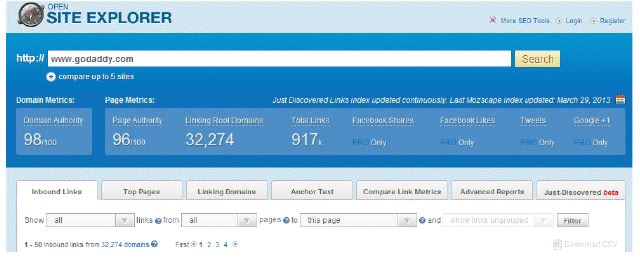
To tell the truth, even the best SEO analyst will need to take time to find out where and what that ground actually is. In most markets, your competitors have spent a decade or more building both their websites, and links to those websites. A thorough competitive analysis will take into account every link that leads to every competitor result that shows up on the first few pages of results that rank for your desired keywords. Link tools like Majestic SEO or Open Site Explorer can be helpful in developing an understanding of where the ground is.

open site explorer

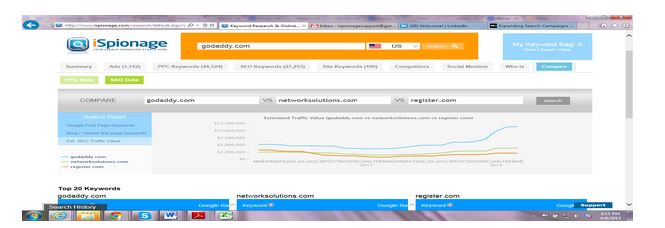
Search marketing competitive analysis tools can also be used to help you assess the level of competition in your domain. These tools are offered by a handful of companies like iSpionage and Spyfu. A new entrant in the web hosting space for instance might use iSpionage’s comparison functionality to assess the level of competition for industry keywords.

When you see large numbers of first page keywords and SEO traffic value in the millions, then you know that competition is going to be fierce. In many markets with entrenched competitors that have been competing for some time, a strategy of optimizing longer-tail terms that will be able to compete within specific industry niches and sub- niches is often the best approach to take.

ispionage

iSpionage Web Hosting SEO Traffic Value Comparison

Build Links from Sites with Authority

Once you or your SEO provider develops these insights, the next step is to find common sites that your competitors use for backlinks. There are often anywhere from 5-100 different sites that all of your major competitors will use for rank-boosting backlinks.
You will need to create a database of every link pointing at the top 50 pages that rank for each one of your keywords. You need to know how many of those links come from the same sites, and from which pages on those sites, and how often. From this, you may be able to see how to grab some of those links for your own site.

Then you need to find links from pages that none of your competition is using. At the very least, you should look for links that a very small percentage of your competition is using. These days, it’s difficult to find quality sites for backlinks, that aren’t already being used extensively. But it is possible. It is also crucial to your success.

As you can imagine, all of this takes time. And it’s only the beginning.

Getting On “Ground Zero” With Your Competitors Takes Time

compassAfter that, you or your provider must procure links in one of several ways: content creation, paid link placement, paid content creation, guest posts, site creation, subdomain creation, link bartering, content trading, etc.

Regardless of whether these links are paid for, traded, or otherwise acquired, dealing with site owners can take time. Blogs and Web 2.0 pages built on your behalf need to be written by good writers who understand SEO–and who probably already have a lot on their plates.

Then, you or your SEO agency should ensure that every image has an appropriate file name, title, and alternate text, specific to (usually) a single keyword, on each page where it appears. And your content should have images, typically, on every single page.

Since a good search engine campaign involves all types of content, your provider will need to make videos on your behalf–and make sure that each video has the right file name, and the right title (for both the video and the page), the right description, and even the right account name.
As you can see, each of the literally thousands–and usually tens of thousands–of links that your site needs in order to rank well, needs to be supported by an entire page that has been precision-engineered in at least a dozen different ways.

As you can see, effective link building takes time. But it is definitely worth the wait.

Google Rarely Trusts Speed

cheetahIn light of the above point, it’s also important to understand that Google is wary of links that gain too much popularity, too quickly.

At one time, you could create hundreds of links literally overnight and reap the benefits. The benefits usually didn’t last, but then you could do it again. And again and again, until you either gained the traction you wanted or got banned from Google’s search engine.

These days, all it takes is a slight portion of unnatural-looking links headed your way in a short period of time to put you on the penalty box with Google. Google may not remove your site from its index entirely, but it may apply such a heavy penalty that you won’t really know the difference.
That doesn’t mean that getting lots of links all at once will instantly sink your ship. In fact, getting hundreds of links from an article that goes viral on Facebook, Twitter, or another social media site, is a recipe for success.

But Google has gotten very good at detecting “link spam”. In fact, some would say it’s gotten a little too good. And while it’s just fine to share your content on Facebook and get as many links as possible in as short a period of time, too many links in too short a time can trigger a manual review. If you or your provider are using techniques that provide too many links too quickly, this review could sink your ship almost overnight.

So if your SEO provider doesn’t build links at quite the pace you’d like to see—rest easy. They’re actually doing you a favor.

Good SEO Takes Fine Tuning Along the Way

Once this work is thoughtfully undertaken, you or your provider will then have to deal with the fact that Google does not stay the same. And neither does Bing and Yahoo!

more ispionage

The way search engines rank sites can change overnight. These changes have brought many profitable websites to their knees, knocking out six-, seven-, and even eight-figure businesses literally overnight. The most dramatic of these updates are known as Panda and Penguin, although there have been others.

At the end of the day, no one but the search engines have control over the SEO landscape. What you do have control over is how you respond to the changes. Good information from good systems and SEO know-how is often the difference between “sink” and “swim” when it comes to the business you conduct online.

Email : naturalseosolution@gmail.com | Mo : 8763723377 | Skype : sunmoon.mohanty

Monday, 29 April 2013

How to Avoid Black Hat SEO Technique

For getting good ranking in various search engines in very short time some webmaster use black hat SEO but is very bed for long terms result for a business website. So if you have any business website than your webmaster must require use white hat SEO as it is best for long terms web promotion for a business website. As a professional white hat SEO we are giving some points of black hat SEO for beginners read carefully and don’t use it. 
  • Don’t use hidden text or hidden link in your website
  • Don’t use sneaky and clocking redirection in your web page
  • Avoid automated query for Google in your website pages
  • Avoid loading heavy pages with irrelevant keywords
  • Don’t use same name for multiple pages
  • Don’t use sub domains  for your website
  • Avoid the pages which are affected with virus and mail worms and which has some malicious behaviors.
  • Don’t use doorway pages in your website
  • Don’t participate in an affiliate program as it is not beneficiary in long terms SEO