Showing posts with label Best research Keyword Tools. Show all posts

Tuesday, 14 May 2013

The Importance of Quality Score in 2013

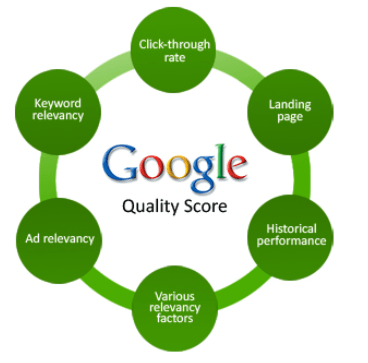
google-quality-score
Everyone in search engine marketing knows that Quality Score is important. But you may not realize that Quality Score is more important now than ever. That’s because as average Quality Scores have fallen over the last 4 years, the benefits you get from having an above-average score is far greater in 2013 than it was in the past.

How much greater? And how can you get a piece of those cost benefits? Let’s start by looking at what a typical Quality Score distribution looks like in 2013.

The Typical AdWords Quality Score Distribution Today

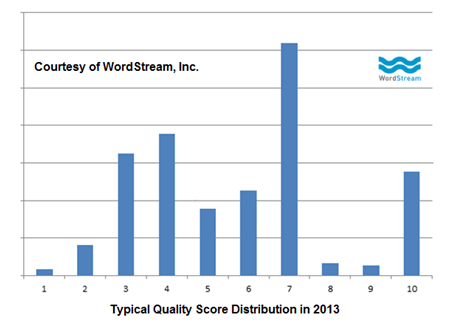
Earlier this year, I manually analyzed several hundred AdWords accounts too look at what the average Quality Score distribution looks like today. Here’s a picture of what the impression-weighted average Quality Score looks like in a typical account:

quality-score-averages
The key takeaway here is that the average Quality Score is now 5/10 (this is down from 7/10 back in 2009). You can see from the chart that Quality Scores of 3/10 and 4/10 are much more common than they were 4 years ago.

Why Quality Score Is Up to 200% More Valuable in 2013

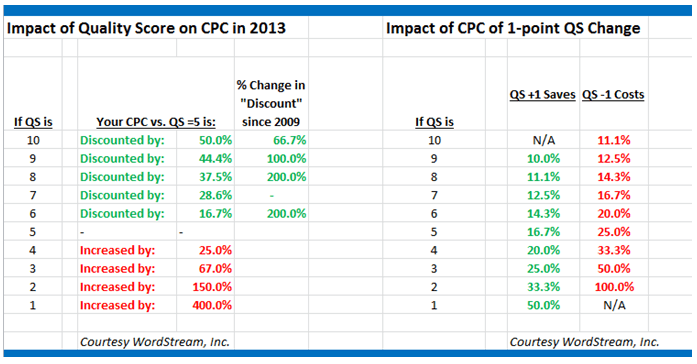
Without getting too technical, I’d like to share some quick data that illustrates the increased importance of Quality Score in AdWords. These tables show the kinds of discounts (or penalties) you can expect to see based on your Quality Score for a given keyword, relative to the average Quality Score of 5/10.

quality-score-discount-table

In 2013, if your keyword has a Quality Score of 10, you can save an estimated 50% on the cost of each click. Note that this is 67% more than you saved four years ago for the same Quality Score. Why? Because average Quality Scores have fallen over time, meaning that higher Quality Scores are even more beneficial and save you more relative to other advertisers.

Figuring out Your Average Quality Score

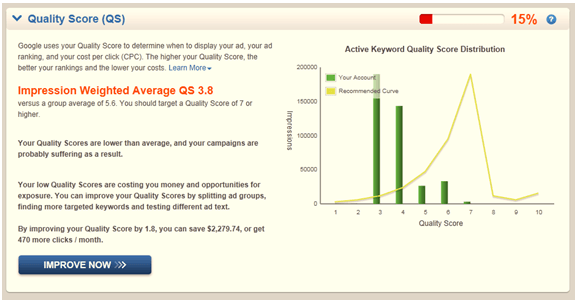
A quick and easy way to figure out your Average Quality Score is to run the my Free AdWords Grader application, which will generate you a Quality Score report card that shows the distribution of your keyword Quality Score and computes the average value as shown here:

calculate-quality-score

3 Non-Obvious Ways to Improve Your Quality Score Now

So how can you raise your own Quality Scores and start seeing these cost benefits? Easy – just raise your Click Through rates. There’s a near straight line relationship between Quality Score vs. CTR. Recently I took a look at a bunch of accounts with +8/10 average quality scores and found the following 3 things in common among the over-achievers.
  1. Bid on Branded Keywords – Branded keywords get on average CTR’s of between 30-80%. This generates a tremendous uplift in your account average CTR, and creates a remarkably beneficial uplift on all the other keyword quality scores in your account. You absolutely must try this out.
  2. Target The Long Tail – Ideally +75% of your impressions should be accrued to keywords with 3+ word keyword phrases.
  3. Stay Active in Your Account – Many PPC account managers are lazy bums that do nothing at all in their AdWords accounts. These clowns go nowhere. All of the top achievers with above 8/10 average Quality Scores were active in their accounts every week, regularly trying out new keywords, deleting lousy keywords, trying out new ads, employing negative keywords, etc.
These are just 3 ways that you can increase your Quality Scores. The key takeaway is that an above average CTR and Quality Score will help you beat your competitors – both in terms of getting more exposure and paying less for your clicks, and that taking action today is worth more than ever! 

Email : naturalseosolution@gmail.com | Mo : 8763723377 | Skype : sunmoon.mohanty

Monday, 6 May 2013

How to keyword research with google keyword tool


Google Keyword Tool


Click This Link Search Your Keyword.

Keyword research is one of the most important, valuable, and high return activities in the search marketing field. Ranking for the "right" keywords can make or break your website. Through the detective work of puzzling out your market's keyword demand, you not only learn which terms and phrases to target with SEO, but also learn more about your customers as a whole.

It's not always about getting visitors to your site, but about getting the right kind of visitors. The usefulness of this intelligence cannot be overstated - with keyword research you can predict shifts in demand, respond to changing market conditions, and produce the products, services, and content that web searchers are already actively seeking. In the history of marketing, there has never been such a low barrier to entry in understanding the motivations of consumers in virtually every niche.


How much is a keyword worth to your website? If you own an online shoe store, do you make more sales from visitors searching for "brown shoes" or "black boots?" The keywords visitors type into search engines are often available to webmasters, and keyword research tools allow us to find this information. However, those tools cannot show us directly how valuable it is to receive traffic from those searches. To understand the value of a keyword, we need to understand our own websites, make some hypotheses, test, and repeat - the classic web marketing formula.
A basic process for assessing a keyword’s value:

Ask yourself...

Is the keyword relevant to your website's content? Will searchers find what they are looking on your site when they search using these keywords? Will they be happy with what they find? Will this traffic result in financial rewards or other organizational goals? If the answer to all of these questions is a clear "Yes!", proceed...

Search for the term/phrase in the major engines

Understanding which websites already rank for your keyword gives you valuable insight into the competition, and also how hard it will be to rank for the given term. Are there search advertisements running along the top and right-hand side of the organic results? Typically, many search ads means a high value keyword, and multiple search ads above the organic results often means a highly lucrative and directly conversion-prone keyword.

Buy a sample campaign for the keyword at Google AdWords and/or Bing Adcenter

If your website doesn't rank for the keyword, you can nonetheless buy "test" traffic to see how well it converts. InGoogle Adwords, choose "exact match" and point the traffic to the relevant page on your website. Track impressions and conversion rate over the course of at least 2-300 clicks.

Using the data you’ve collected, determine the exact value of each keyword.

For example, if your search ad generated 5,000 impressions, of which 100 visitors have come to your site and 3 have converted for total profit (not revenue!) of $300, then a single visitor for that keyword is worth $3 to your business. Those 5,000 impressions in 24 hours could generate a click-through rate of between 18-36% with a #1 ranking (see the Slingshot SEO study for more on potential click-through rates), which would mean 900-1800 visits per day, at $3 each, or between 1-2 million dollars per year. No wonder businesses love search marketing!
Even the best estimates of value fall flat against the hands-on process of optimizing and calculating ROI. Search Engine Optimization involves constant testing, experimenting and improvement. Remember, even though SEO is typically one of the highest return marketing investments, measuring success is still critical to the process.


Going back to our online shoe store example, it would be great to rank #1 for the keyword "shoes" - or would it?
It's wonderful to deal with keywords that have 5,000 searches a day, or even 500 searches a day, but in reality, these "popular" search terms actually make up less than 30% of the searches performed on the web. The remaining 70% lie in what's called the "long tail" of search. The long tail contains hundreds of millions of unique searches that might be conducted a few times in any given day, but, when taken together, they comprise the majority of the world's demand for information through search engines.
Another lesson search marketers have learned is that long tail keywords often convert better, because they catch people later in the buying/conversion cycle. A person searching for "shoes" is probably browsing, and not ready to buy. On the other hand, someone searching for "best price on Air Jordan size 12" practically has their wallet out!
Understanding the search demand curve is critical. To the right we've included a sample keyword demand curve, illustrating the small number of queries sending larger amounts of traffic alongside the volume of less-searched terms and phrases that bring the bulk of our search referrals.
The Long Tail
Long Tail Illustration Ignore the long tail at your peril - search marketing and web site content strategies must allow for this “impossible to predict” form of visits or risk  losing out on a more expository and prolific competitor.
Google Analytics Illustration
Google’s AdWords Keyword Tool provides suggested keyword and volume data.


Resources

Where do we get all of this knowledge about keyword demand and keyword referrals? From research sources like these listed here:
Google's AdWords Keyword tool is a common starting point for SEO keyword research. It not only suggests keywords and provides estimated search volume, but also predicts the cost of running paid campaigns for these terms. To determine volume for a particular keyword, be sure to set the Match Type to [Exact] and look under Local Monthly Searches. Remember that these represent total searches. Depending on your ranking and click-through rate, the actual number of visitors you achieve for these keywords will usually be much lower.
Other sources for keyword information exist, as do tools with more advanced data. The SEOmoz blog category on Keyword Research is an excellent place to start.


What are my chances of success?

In order to know which keywords to target, it's essential to not only understand the demand for a given term or phrase, but also thework required to achieve those rankings. If big brands take the top 10 results and you're just starting out on the web, the uphill battle for rankings can take years of effort. This is why it's essential to understand keyword difficulty.
SEOmoz Keyword Difficulty
Different tools around the web help provide this information. One of these, SEOmoz’s own Keyword Analysis Tool does a good job collecting all of these metrics and providing a comparative score for any given search term or phrase.

Thursday, 2 May 2013

WeChat Marketing: Another Way to Reach China’s Affluent Consumers


China’s unprecedented growth is attracting businesses from all corners, hoping to cash in on 250 million middle class consumers. In three short decades, it has become one of the most competitive marketplaces in the world. With the average Shanghai consumer exposed to more than three times the advertising of their British equivalent, marketers need to use their marketing resources wisely to break through the clutter.

WeChat (know as Weixin in Chinese) is one of the marketing channels businesses are
finding success in reaching Chinese consumers. The mobile instant messaging service
is China’s home-grown answer to WhatsApp and, unlike many Chinese clones, it’s
innovated a few clever new features. Launching just two years ago, WeChat has already
clocked up more than 300 million users. The last 100 million users were added in less than 4
months. WeChat has become a popular way for urban Chinese communicate, and even
has China’s state-run mobile operators lobbying to enforce charges for WeChat as it is
cannibalizing so much of their revenue.

we chat

Who’s using WeChat?

China’s young, affluent and urban make up the majority of WeChat users. 74% of the
300 million are in their 20s, and as you need a smartphone to download the app, users
tend to have higher than average incomes. WeChat user profiles closely resemble
consumers who are most likely to buy foreign products and be more loyal to a brand.

What Makes WeChat an Effective Marketing Tool in
China?

WeChat provides another way to build loyalty and promote your wares to Chinese
consumers. While communications don’t have viral potential of social media services
such as Weibo, messages can be much more targeted and are almost guaranteed to
be read. WeChat messages can be text, images, sound and videos, can be location-
relevant and can be sent to groups or singles. Given 38% of Chinese smartphone users
use their mobiles more than five hours a day, checking them every six minutes on
average; your audience is well engaged. If executed well, WeChat can be an effective
way to communicate with your Chinese target market and complimentary to your other
marketing.

How best to Market on WeChat:  First Off, You Need To Attract Followers

To be successful on WeChat, you need followers. Unlike some channels, most WeChat
users won’t find you through a search; it’s all about your QR Code. WeChat allows you
to simply create a QR Code allowing WeChatters to do a quick scan to become a fan.
Without overdoing it, ensure customers can find your QR Code: post it on your website,
on your packaging, social media, in your store and on your advertising – if it’s easy to
scan. WeChat also has an API that allows you to integrate the service into mobile apps
to attract followers. Be aware that consumers who follow a businesses on WeChat are
letting them into their inner circle, so you need to give them a good reason to sign up.
You can offer coupons, prizes, entertainment, pictures, WiFi access, POS promotions,
VIP treatment or support. Get creative. WeChat has some handy features such as
finding other users close by, or sending a message in the bottle to random users, as
you’ll see in some of the success stories below.

Help Your Followers Love Your Brand and Act upon it

Once you’ve got the followers, you can send communications to individual users or
specific groups. It’s a good idea to tailor your messages to make them relevant and
personal. News, coupons, offers and promotions, VIP membership, entertainment and
general pieces of interest all work well. Amongst the mass of people in China, Chinese
consumers like to feel exclusive, especially for luxury brands, and WeChat allows you
to create exclusive clusters for VIP customers. It can also provide a useful forum for
research focus groups. Soon brands will be able to offer customizable menus on their
WeChat pages to allow shopping and other features such as recommending close-by
shops. Watch this space.

Be Responsible

Remember when someone follows you on WeChat, they are letting you into their pocket
or handbag. Don’t abuse that privilege. Each time you send a message, it may interrupt
your follower and they will almost certainly read it, so make it relevant, personal and not
too frequent. Treat it like you were sending an SMS to someone, short, to the point and
not too salesy. And be aware that WeChat messaging isn’t just one-way; customers may
want to have a conversation, so ensure you have the proper resources and automated
tools to handle that.

Who’s Doing it Well?

WeChat QR-Codes are increasingly popping up across China and on the web as more
businesses hope to increase their fortunes with the channel. Here are some of success
stories of those who have:

Starbucks Songs for your Mood:

Starbucks has long been one of the pin-up kids of social media in China and its WeChat
initiatives are no exception. Starbucks’ most successful campaign utilized WeChat’s
features by asking consumers to share their mood by sending one of WeChat’s 26
emoticons to the Starbucks WeChat account. They’d then receive a song through
WeChat that reflected their mood. After a few months, 130,000 members had joined,
having shared their emotions 238,000 times. In addition, it increased awareness and
sales of their new fruity-iced drinks and increased Weibo users increase 9%.

Nike Sports Festival Game

Nike, another star of Chinese social media, was quick to jump on the WeChat wagon. At
the annual Nike Sports Festival in Shanghai, attendees could scan the Nike WeChat QR
Code to partake in a badge-collecting game that combined WeChat with the movement
tracking Nike + technology. It was a fun and interactive way to win prizes, meet sports
stars and access rich content on the Nike WeChat page. The number of registered users
grew from 1,256 on day 1 to 11,999 on day 4 as word spread, engaging a total of 22,000
consumers over the festival.

Chinese Merchant Bank Helping Autistic Kids

In a novel way to build up their fan base, CMBC used WeChat’s Message in a Bottle
feature to randomly send messages to WeChat users picking up random bottles. For
every 500 replies, the bank funded training for an autistic child in China. More than 20
million replies were received.

Cadillac Route 66

Many Chinese consumers love American culture, so Cadillac played well to that with
the classic Discover Route 66 campaign on WeChat, sending users daily updates, info
and rich content from different spots along the highway in addition to weather and safety advice.


Joy City Membership

Joy City, a popular chain of shopping malls across China, worked with more than 40 of
its food, fashion and cosmetics retailers in a WeChat campaign. Shoppers were invited
to scan the in-store QR codes to get a Joy City membership card. Once registered,
members could use their card or their smartphone for privileges such as discounts and
giveaways.

Hollywood Celebs:

With China’s movie and music industry soaring, WeChat is seeing its share of western
celebrities hoping to build their brand in China including Selena Gomez, John Cusack,
Maggie Q, Paris Hilton, Adam Lambert, Nina Dobrev and the Backstreet Boys – sending
everything from photos to sound bites wishing a Happy New Year in Chinese.

In Conclusion

While WeChat isn’t the panacea for all marketing in China, it can be an effective piece
of the puzzle to build loyalty and increase sales in one of the world’s most competitive
markets. Popularity is also soaring in other parts of Asia, so it’s a good idea to get on top
of it if you’re selling internationally.

Email : naturalseosolution@gmail.com | Mo : 8763723377 | Skype : sunmoon.mohanty

    Contact Us

    Natural SEO Solution (NSS)

    Bhubaneswar, Pin – 751017, Odisha, India

    Email Id: naturalseosolutions@gmail.com

    Skype: sunmoon.mohanty

    Mo: 91 8763723377

    Follow Us