Showing posts with label Meta Keywords. Show all posts

Tuesday, 14 May 2013

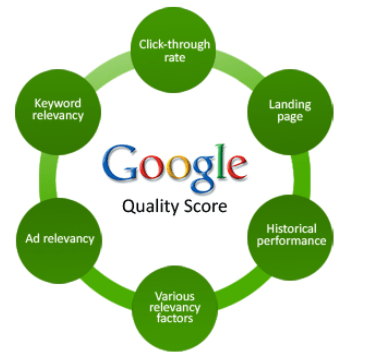
The Importance of Quality Score in 2013

google-quality-score
Everyone in search engine marketing knows that Quality Score is important. But you may not realize that Quality Score is more important now than ever. That’s because as average Quality Scores have fallen over the last 4 years, the benefits you get from having an above-average score is far greater in 2013 than it was in the past.

How much greater? And how can you get a piece of those cost benefits? Let’s start by looking at what a typical Quality Score distribution looks like in 2013.

The Typical AdWords Quality Score Distribution Today

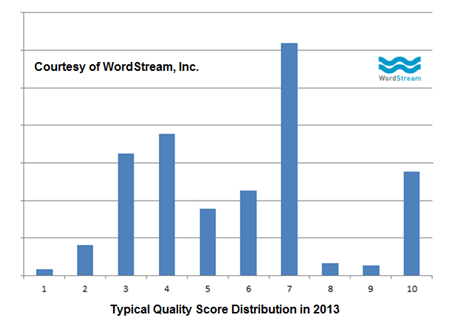
Earlier this year, I manually analyzed several hundred AdWords accounts too look at what the average Quality Score distribution looks like today. Here’s a picture of what the impression-weighted average Quality Score looks like in a typical account:
quality-score-averages
The key takeaway here is that the average Quality Score is now 5/10 (this is down from 7/10 back in 2009). You can see from the chart that Quality Scores of 3/10 and 4/10 are much more common than they were 4 years ago.

Why Quality Score Is Up to 200% More Valuable in 2013

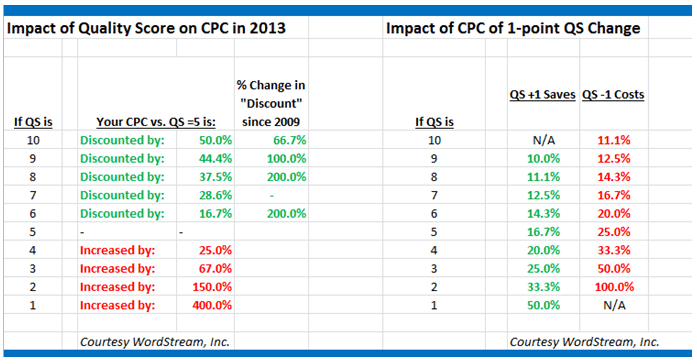
Without getting too technical, I’d like to share some quick data that illustrates the increased importance of Quality Score in AdWords. These tables show the kinds of discounts (or penalties) you can expect to see based on your Quality Score for a given keyword, relative to the average Quality Score of 5/10.
quality-score-discount-table

In 2013, if your keyword has a Quality Score of 10, you can save an estimated 50% on the cost of each click. Note that this is 67% more than you saved four years ago for the same Quality Score. Why? Because average Quality Scores have fallen over time, meaning that higher Quality Scores are even more beneficial and save you more relative to other advertisers.

Figuring out Your Average Quality Score

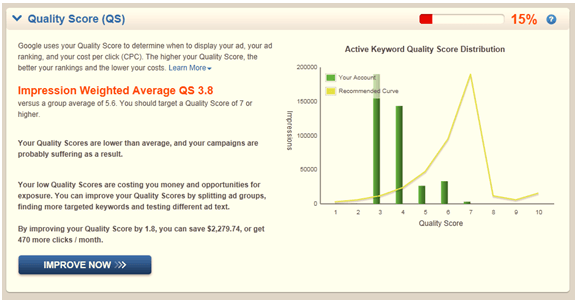
A quick and easy way to figure out your Average Quality Score is to run the my Free AdWords Grader application, which will generate you a Quality Score report card that shows the distribution of your keyword Quality Score and computes the average value as shown here:
calculate-quality-score

3 Non-Obvious Ways to Improve Your Quality Score Now

So how can you raise your own Quality Scores and start seeing these cost benefits? Easy – just raise your Click Through rates. There’s a near straight line relationship between Quality Score vs. CTR. Recently I took a look at a bunch of accounts with +8/10 average quality scores and found the following 3 things in common among the over-achievers.
  1. Bid on Branded Keywords – Branded keywords get on average CTR’s of between 30-80%. This generates a tremendous uplift in your account average CTR, and creates a remarkably beneficial uplift on all the other keyword quality scores in your account. You absolutely must try this out.
  2. Target The Long Tail – Ideally +75% of your impressions should be accrued to keywords with 3+ word keyword phrases.
  3. Stay Active in Your Account – Many PPC account managers are lazy bums that do nothing at all in their AdWords accounts. These clowns go nowhere. All of the top achievers with above 8/10 average Quality Scores were active in their accounts every week, regularly trying out new keywords, deleting lousy keywords, trying out new ads, employing negative keywords, etc.
These are just 3 ways that you can increase your Quality Scores. The key takeaway is that an above average CTR and Quality Score will help you beat your competitors – both in terms of getting more exposure and paying less for your clicks, and that taking action today is worth more than ever! 

Email : naturalseosolution@gmail.com | Mo : 8763723377 | Skype : sunmoon.mohanty

Monday, 29 April 2013

Best Way To Write A Title Tag For Better Search Engine Optimization


What makes you read an article at once? What is that driving force that makes you feel that an article might be interesting? The answer to these questions is the title of an article. The title of a page is the most important constituent of an article which tells the search engine about the content of your page.
In order to increase the traffic on your page, that is to increase the number of visitors on your page, you need to have an effective title tagline for SEO and you also need to have an interesting title for the readers.
For example, if you Google “how to write a resume” the first and the top most search result will be the exact match of your search. The title for this article was molded in such a way that it appears at the top in the search list.   However when you go through the search results, you find 2nd and 3rd article titleds “How To Write A Resume, Resume Writing, Sample Resume” and “How to Make a Resume (with Free Sample Resumes)” respectively. Although the top result was taken by the exact match of our search, but this article even more click worthy since it includes words like “Free Sample Resumes“.
how to write a resume
Screenshot – april 10, 2013 (Google.com)
Note : By seeing the above picture you may argue that the first article has more chances of attracting the visitors because there is Google plus author profile linked to it, despite being simple compared with 2nd and 3rd search result. But my point here is only to compare the titles and see how effective is 2nd and 3rd results without considering the Google profile pic.
In the above example you can see the 2nd result – “How To Write A Resume, Resume Writing, Sample …. ” and if you want to see the complete title, just open the site in any browser and keep the cursor over the tab and you can see the see the complete title like the picture below:
browser cursor
The above mentioned example surely suggests on how you need to design your title, which not only appears among the top search results but also has an eye catching and interesting title to force the visitors to click on it.
Before jumping onto any conclusion regarding the process of making a title interesting and make it appear at the top of the search list, it is necessary to know a few details.

Meta Tags

These are XHTML elements that are used to deliver any information about the website’s page to the users of the website and search engines. These elements include
  • Title tag lines
  • Description
  • Keywords

Know about title tags

These are the part of Meta tags, which are present around the top most part in the HTML covered under the <head> area. Similar to the titles of the chapters that you have in a book, these title tags tells the search engines and the readers about the content of your page. It is the title tag of your page which will make the persons searching on the search engines to make a decision whether they must look into your page or not.
Not only this, title tag must contain some of the keywords which will enable search engines to understand what your page is all about. The title tags must be designed in such a way that they should appear catchy for the human eyes and should also be formatted according to the needs of search engines.
You must always remember that it is the title tag is the most important tag which tells the search engine about the content of your page. It is also equally important for your SEO strategy.
Here are some of the ways in which you may end up giving a good title to your page which will surely boost the traffic on your site.

Write a Reader Friendly Title

In the previous example we have already seen that the search result that came on top of the result was left behind by the one which was amongst the tops and also had an effective and interesting title added to its page. The title “10 east steps to make a cake” when referred to one’s website, does not sound as ambiguous as it appears to be in a search result.
Whenever you are writing a title tag for your page, there are bound to be several questions in your mind. Here, we try to answer the most important ones.
  • What are the norms about the length of the title tag?
The length of the article must not exceed 70 characters. Secondly, you should invest adequate thought in the placement of keywords.
At this point, you could ask – what if you are writing a language that goes from right to left? Or, what if your target audience is from a country having these language norms? Well, in these cases, you have to reverse the order.
  • How shall I go about the construction of the title tag in terms of placement of words?
The important and more descriptive of the keywords must come in the initial parts of the title tag, and the less important ones must be kept for the latter parts.
  • What if I need to use similar important words?
In such cases, you may use pipes in order to distinct important phrases. You must also see to it that you do not have any commas, exclamation mark, underscores or other punctuations in your tag.
  • Is using the name of my company in the title tag advisable?
Use the name of the company in the title tag only when the name forms a portion of your tag. Most of the SEO‘s advice to either leave them out or to place them at the last of you title tag.
  • Is it a go0d idea to use my keyword repeatedly in the title
Email : naturalseosolution@gmail.com | Mo : 8763723377 | Skype : sunmoon.mohanty