Showing posts with label SMO Pricing. Show all posts

Wednesday, 12 June 2013

Why Social Media Listening is Important for Brands

are-you-listening

Are you missing out on opportunities to increase sales and ROI, or to increase media value, awareness, and virality? You just might be.

If you're running social media for your business, you must listen to your consumers and respond quickly in order to be fully effective.

Here are some real cases from large brands that illustrate why you should be listening to your audience on social media. These insights come from Tami Dalley, senior director at Salesforce, who spoke on the Social Media Meet ROI: The Secrets to Driving Social Commerce panel at SES New York earlier this year.

Why Should You Listen? – The Lululemon Story

Dalley mentioned an incident with brand Lululemon Athletica and how the fitness-wear retailer stocks declined after it was forced to withdraw women's pants that proved to be too transparent. Many people took to social media to express their thoughts on the matter.

lululemon-yoga-pants-tweets

The brand also started talking on social media, however it was on unrelated topics that had nothing to do with the incident of the see-through pants. The Lululemon website was also completely void of any information regarding the incident.

This wasn't a good move on their part, Dalley said. The brand should have responded to their customers, instead of ignoring the issue.

Lessons learned from LuLulemon not listening:
  • During a crisis people start to talk, so it's up to the brand to respond.
  • The brand is not longer the marketer, but the customer is.
  • Social media listening helps us understand real conversations, real people, and what they want.
  • Social media can increase or decrease a brand's impact on their campaign success.
  • And if social media is done effectively, can increase revenue and sales.

So Why Don't Brands Listen?

One reason that brands don't listen is because there's an overwhelming amount of social media noise and data out there. It's hard to separate the signal from the noise; therefore companies must invest in technology so they can actively listen.

Listening insights can have implications for multiple stakeholders, and each department within a company has unique needs and therefore distinct listening objectives.

Benefits Various Departments Can Have Listening to Social Media

social-listening-insights-departments
Customer service:
  • Create a knowledge base from questions and answers they find on social media.
  • Identify and solve problems.
  • Integrate with CRM to prove cost savings.
Marketing and public relations:
  • Uncover conversations about brand, industry, products and respond in real time.
  • Leverage topic insights to improve their content, SEO, and PPC strategy.
Product:
  • Listen in social media for various product problems.
  • Highlight success of a product launch.
  • Gain input and ideas from customers on how to improve the product. It's not only a great way to gain further insight into their product, but it's also free to do so.
Sales:
  • Uncover conversations that indicate intent to purchase (e.g., “Can anyone recommend”, “I need a new …”).
  • Keep an ear out for discontent with competitors.
  • Prove ROI through CRM integration.
Human resources:
  • Find where to fish for recruits.
  • Uncover the experts and influencers.
  • Discover perception of you as employer.
  • Listen for issues that impact employees happiness.

How Companies Use Social Media to Gain Insight into Their Brand

Taylor Guitars was listening and identified peaks in conversation, which led them to Dave Carroll's protest song on YouTube. The song chronicles an incident of how Dave's guitar (which was a Taylor Guitar) was damaged due to attendants of United Airlines recklessly throwing luggage into the plane. United Airlines denied Dave's claim, so he took to social media to express his disappointment.


Taylor Guitars Uses Social Media for Marketing & PR

  • Uncovered conversations about their brand, products, and industry.
  • Respond in real time to opportunities.
  • Leveraged topic insights to improve SEO and PPC.
Taylor Guitars was listening and identified peaks in conversation, to which they found Dave's Story. Taylor Guitars responded in real time and reaped benefits of social listening.


What Taylor Guitars did:
  • They remained authentic by expressing who the damage to a guitar you love sucks
  • They took the opportunity to educate Dave and the consumer by stating that sometimes you can take it on the plane.
  • They promoted their repair service by mentioning that they would be willing to fix Dave's guitar as well as other guitar brands too.

Maker's Mark Uses Social Media to Listen to Their Consumers and Fix Their Product

Maker's Mark had an explosion of conversation when their COO announced that they were going to reduce the amount of alcohol in their product. Demand was too high and Maker's Mark couldn't produce the product fast enough. One of their solutions was to reduce the alcohol content so they could mass-produce the product faster.

Unfortunately after that announcement, various customers took to Twitter to announce their displeasure for this move.

makers-mark-dilute-tweets

After Maker's Mark noticed the conversation that was happening online, they quickly responded:
makers-mark-you-spoke-we-listened
makers-mark-heres-proof

They listened to the response their consumers were giving them on social media and immediately reversed their decision to dilute their product. This is yet another example how social media was able to help brands:
  • Become aware of problems with their product.
  • Get input and ideas from customers.
  • Utilize real time focus groups.
Maker's Mark also took their social message through to paid search and their sentiment switched from negative to positive.

makers-mark-you-spoke-paid-search

Social Listening Takeaways


As Dalley's insights and case studies have illustrated, it's important for brands to invest in social listening across the entire organization, and use technology to separate the signal from the noise. Find out where conversations are happening, and leverage what you learn, don't ignore your customers. Listening without action will only annoy your customers.

Email : naturalseosolution@gmail.com | Mo : 8763723377 | Skype : sunmoon.mohanty
Thursday, 23 May 2013

Social Graph & Sociographics – How to Use Friends to Influence People

In this day and age, we’re all part of networks and groups of peers that communicate and interact multiple times a day. With the rise of social media and other interactive networks, it is easier than ever before to reach out to someone and get information directly from the source. This is never more prevalent than in the realm of social influence.

Let’s take this scenario: It’s Friday night; you’re new to the area and want to go out for dinner but don’t know where to go, and more importantly where is good to eat. So you jump online and search for something like “best restaurants in St Kilda”. It brings up many different results within a close distance to your home, and you spend 20 minutes sifting through menus and making judgments on which restaurant is the best.

As you’re leaving the office, your colleague Michael recommends a “really great restaurant with fabulous food and a fun atmosphere”. So now you have two restaurants in mind – do you trust your friend or the search results?

The evolution of the internet and other technology such as smartphones and hand held devices gives us immediate online access where we can leave and find reviews on absolutely anything. Why trust the brand itself when we can read consumer opinions based on experience?

The following discusses a relatively new form of market segmentation called “sociographics”. This concept is defined by Tom Philips as “The science of creating targeting models, based on the connections between people and brands”.

This article details the case of why “sociographics” will be the way in which marketers target their customers in the future.

Market Segmentation in the Digital Age

The world of Marketing has seen significant change in the past decade with the development of the Internet. This traditional model has been around since the industrial era. It focused on one message being pushed out to consumers via means such as TV, newspapers and billboards. Typically, marketers bought ad space on these traditional platforms where their ad was then exposed to the public where it was hoped that individuals would respond positively to the message either by purchasing the product, changing their behavior, or developing a favourable impression of the brand.

As outlined by Kevin Lane Keller, in order for a person to be persuaded they must go through 6 steps:
  • Exposure to the ad
  • Attention: Person must take notice
  • Comprehension: Person must understand the intended message
  • Yielding: Person must respond favorably to the intended message
  • Intentions: Person must plan to act in the desired manner
  • Behaviour: Person must actually act in the desired manner.
The laws of probability suggest the likelihood of all six points successfully occurring is around 1.5%. This low Return on Investment is one of the reasons why marketers have lost face in the boardroom.

A lack of effectiveness from marketing practice, and its public perception of being “manipulative” have led to a lack of consumer trust. No trust means you can’t build relationships, and in turn price becomes the main focus. This is a dangerous position for companies to be in as price is one dimensional-up or down; whereas value is multidimensional and is based on the consumers’ interpretation of the brand.
“Price is what you pay, value is what you get” – Warren Buffett
We have now seen a shift of consumer trust from businesses to peers through the Internet. Although the rise of consumer empowerment, media fragmentation and increased “noise”, is seen as a challenge for a number of traditional marketers, it can also be seen as an opportunity. The opportunity lies in mining through the network value that a customer has on the Internet through “Sociographic Segmentation”.

Why Next Generation Marketing will revolve around “Sociographics”

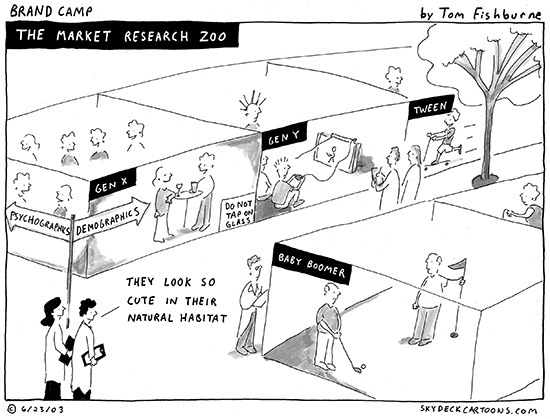
market research

Source: http://tomfishburne.com/2003/06/the-market-research-zoo.html
In the traditional form, target marketing had been done usually by demographics (age, sex, gender) and psychographics (lifestyles, activities, interests). The Internet has broken down the demographic and psychographic barriers. People are now coming together based on communities of affinity.
As highlighted by Seth Godin’s talk (http://goo.gl/jQhw1) the Internet has changed our world because it allows people to be connected. It has split the world up into a variety of different niches, from Ukrainian Folk dancers to Vegemite fanatics. It has allowed people to build emotional relationships with like-minded people. These relationships (like most) are based on the concept of trust; which for marketers, as we know, has decreased significantly.
It is relatively common knowledge in the marketing world that 30% of purchase decisions are rational, while 70% of purchase decisions are emotional. Demographics do not tell marketers how to reach people emotionally, or indeed physically. Sociographics do.
“We are not thinking machines that feel; we are feeling machines that think” – Antonio Demasio
What are Sociographics?
“Sociographics” or studying the social graph is a fairly recent phenomenon. On a basic level, this new way of targeting customers is to go after existing customers and find their friends.

The increase in sales to others that result from marketing to an influential customer is called the network value of a customer. Sociologists know that in any group, emotions ripple outward with the strongest concentration of emotion coming from the most powerful person in the room. So why can’t marketers use this approach in the online environment?

Awareness or adoption spreads from consumer to consumer through social networks, blogs, Internet chat & more recently, mobile phones, making words such as “trust”, “community” and “engagement” evermore important for digital marketers. Firms are now being able to use their websites to facilitate consumer-consumer advocacy via product recommendations or via online customer feedback mechanisms.

New forms of technology are allowing people to interact with each other more frequently and share information, values, and ideas. Early research has shown that marketing to people socially connected to an existing customer of a product has 3-5 times higher response rate to advertising versus traditional methods.


Peer-to-peer communication is now the way consumers get their news. The Internet has allowed companies to build individual customer profiles more easily. This will allow marketers to understand the values, needs and wants of potential consumers and help build customer loyalty. This can be done by targeted advertisements and personalisation.

Email : naturalseosolution@gmail.com | Mo : 8763723377 | Skype : sunmoon.mohanty

Monday, 29 April 2013

How Social Media is Changing the SEO Industry


It is painfully cliché to talk about “the rise of social” and “the power of social media.” That happened a long time ago. Now it’s settled, and we can make some real progress.
The power of social lives on beyond its ubiquity, and wields a transformative impact on SEO. Please understand that I’m not going to propagate any myths about how to increase your rankings via social media. Nor am I going to propose that SEO-is-dead-so-long-live-social. Instead, I’ll attempt to demonstrate how social is infringing upon the traditional realm of SEO as a major factor in how people find information, convert, and interact with the Internet.

The argument over the correlation of social likes and search rankings is moot. 
First, social likes are important. Their impact upon search rankings, however, is not relevant to this discussion.
Bloggers and pundits love to discuss the search ranking value of an active social presence. “Do Facebook ‘Likes’ Increase Search Rankings,” asks one author. (Her answer, interpreted:  ”Uh, we’re not sure.”) Groupon explains “How to Improve Your Search Rankings with Social Media.” Others croon that Facebook comments can improve one’s rankings.
There’s little value in debating such claims. The studies are inconclusive. What we need to do now is determine what real changes have taken place that actually affect searches.
Social Factors That Impact SEO
Keep in mind that SEO is alive and well. Yet along with the continued impact of SEO is the increasing dependence upon social for how people search, find, and respond to information. Here are the major factors that are forming this social search trend.
1.    Personalized search results.
By default, Google returns results that are most relevant to you personally, assuming you are logged in to a Google account. If you look in the upper right corner of your search results page, here’s what you’ll see:
personalization
The icon circled in red indicates that your SERP is “currently showing personal results.” Clicking the globe icon will “hide personal results.” Personal results dish up all the general content that correlates with your search, but will also show “pages, photos, and Google+ posts from your friends,” according to Google’s explanation. Google personalizes search results in order “to deliver you the most useful, relevant content for your search.”
When I searched for “Google authorship,” I returned a list of results, including this one:
google authorship
See the circled icon? That informs me that this is a personalized search result. Search Engine Land is in my Google Circles. Thus, they get position number five on my personal SERP, and are denoted by the image.
Personalized results have a huge impact for real life. If you search for a lawn care company, you’re likely to return top-ranked results that your friends have +1ed. If you look for pictures of “horses” and your friend has photos of her appaloosa on her Google+ account, that’s what will top the list of pictures.
Larry Magid bemoans personalized search results in his Huffington Post article. He bases his complaints on “privacy and antitrust concerns” and “biased results.” He has a point: “It kind of ruins what Google spent so many years building.”
Hate it or love it, personalized search results mean that search engine optimization loses influence. Instead, personalized search factors bear heavily upon which returns feature prominently in your results.
You can thank social for this massive change in how SEO works.
2.  Anything “viral” is social. 
Everyone has felt the impact of viral content, clips, or trends. Admit it — you watched Gangam Style, along with more than 1.5 billion other people.
The whole viral trend is built on the power of social media. Nothing goes viral unless it is “shared,” and nothing is shared unless it happens via social media.
You simply can’t pull off a viral trend by performing some SEO tricks. It has to be social.
3.    The Social Foundation of Local Search
Local search has experienced a radical transformation since the advent of Google Places and Yahoo! Local. The results delivered by these sites are built upon social interaction and the weight of social profiles, whether business entities or individuals. From Facebook check-ins, to Yelp ratings, to Foursquare interaction, local search depends heavily upon social involvement.
4.    The Impact of Google+ 
Google+ is a game changer. I’ve already mentioned how personalized search results are determined based on who posts what in your circles. There are other major changes besides.
Let’s take one example. Google results now show the picture of the author next to the content. You’ve probably seen search results that look like this:
authorship markup
Those smiling mugs get a 150% increase in click-through rates over their non-pictured counterparts according to Catalyst. It pays to be seen. In other words, it pays to be active on social networks like Google+. That’s where these pictures originate — a bit of rich snippet wizardry and Google authorship verification on Google+.
Google+ is the single most powerful social force on the Internet today. Facebook may have a bigger market share, but Google+ has a bigger ownership of search power. Facebook doesn’t write the algorithms; Google does.
What’s more, Google+ isn’t just a social network; it’s a personalized web experience that extends to your every interaction with Google products. The persistent Google navigation bar keeps you constantly in tune with a personalized web experience:
google nav bar
This means that you’re never more than a click away from the social spin on whatever it is you’re doing.
5.    Social network searches
Much of our interaction with the web comes through our social channels. In addition to Googling, you’re also visiting sites by means of the following methods:
  • Clicking links that your friends post on Facebook
  • Viewing Tumblr accounts
  • Clicking all those bit.ly links on Twitter, even though you don’t know what they link to
  • Checking out articles that have been +1ed by people in your Google+ Circles
Web users spend a lot of time on social media. Their engagement with the web is built on how they interact with their social circles. Data from one social media research project in late 2012 revealed that 18% of the time spent online is spent on social media.
Often, rather than search for a site on Google, people will search for a site’s social profile. A Facebook business page provides excellent at-a-glance results for a local establishment’s business hours. In fact, it’s way better than navigating to the business website, tracking down the information, and hunting for the business hours. The Facebook page instantly shows the business hours.
One of the most powerful effects of a social network is the way it transforms customer decision-making. Search Engine Land’s 2012 study stated, “72% of consumers trust online reviews as much as personal recommendations.” More than half of consumers agreed that positive online reviews increased their likelihood of using a local business. E-consultancy declares that 88% of customers will consult reviews before finalizing an online purchase. Even conversion rates are affected by social.
Again, social media is jostling with SEO for dominancy in how people find what they’re looking for, and how they make their decisions.
Mail Us : naturalseosolution@gmail.com | Ph : 8763723377 | Skype : sunmoon.mohanty