Showing posts with label Social Media Marketing. Show all posts

Wednesday, 12 June 2013

Why Social Media Listening is Important for Brands

are-you-listening

Are you missing out on opportunities to increase sales and ROI, or to increase media value, awareness, and virality? You just might be.

If you're running social media for your business, you must listen to your consumers and respond quickly in order to be fully effective.

Here are some real cases from large brands that illustrate why you should be listening to your audience on social media. These insights come from Tami Dalley, senior director at Salesforce, who spoke on the Social Media Meet ROI: The Secrets to Driving Social Commerce panel at SES New York earlier this year.

Why Should You Listen? – The Lululemon Story

Dalley mentioned an incident with brand Lululemon Athletica and how the fitness-wear retailer stocks declined after it was forced to withdraw women's pants that proved to be too transparent. Many people took to social media to express their thoughts on the matter.

lululemon-yoga-pants-tweets

The brand also started talking on social media, however it was on unrelated topics that had nothing to do with the incident of the see-through pants. The Lululemon website was also completely void of any information regarding the incident.

This wasn't a good move on their part, Dalley said. The brand should have responded to their customers, instead of ignoring the issue.

Lessons learned from LuLulemon not listening:
  • During a crisis people start to talk, so it's up to the brand to respond.
  • The brand is not longer the marketer, but the customer is.
  • Social media listening helps us understand real conversations, real people, and what they want.
  • Social media can increase or decrease a brand's impact on their campaign success.
  • And if social media is done effectively, can increase revenue and sales.

So Why Don't Brands Listen?

One reason that brands don't listen is because there's an overwhelming amount of social media noise and data out there. It's hard to separate the signal from the noise; therefore companies must invest in technology so they can actively listen.

Listening insights can have implications for multiple stakeholders, and each department within a company has unique needs and therefore distinct listening objectives.

Benefits Various Departments Can Have Listening to Social Media

social-listening-insights-departments
Customer service:
  • Create a knowledge base from questions and answers they find on social media.
  • Identify and solve problems.
  • Integrate with CRM to prove cost savings.
Marketing and public relations:
  • Uncover conversations about brand, industry, products and respond in real time.
  • Leverage topic insights to improve their content, SEO, and PPC strategy.
Product:
  • Listen in social media for various product problems.
  • Highlight success of a product launch.
  • Gain input and ideas from customers on how to improve the product. It's not only a great way to gain further insight into their product, but it's also free to do so.
Sales:
  • Uncover conversations that indicate intent to purchase (e.g., “Can anyone recommend”, “I need a new …”).
  • Keep an ear out for discontent with competitors.
  • Prove ROI through CRM integration.
Human resources:
  • Find where to fish for recruits.
  • Uncover the experts and influencers.
  • Discover perception of you as employer.
  • Listen for issues that impact employees happiness.

How Companies Use Social Media to Gain Insight into Their Brand

Taylor Guitars was listening and identified peaks in conversation, which led them to Dave Carroll's protest song on YouTube. The song chronicles an incident of how Dave's guitar (which was a Taylor Guitar) was damaged due to attendants of United Airlines recklessly throwing luggage into the plane. United Airlines denied Dave's claim, so he took to social media to express his disappointment.


Taylor Guitars Uses Social Media for Marketing & PR

  • Uncovered conversations about their brand, products, and industry.
  • Respond in real time to opportunities.
  • Leveraged topic insights to improve SEO and PPC.
Taylor Guitars was listening and identified peaks in conversation, to which they found Dave's Story. Taylor Guitars responded in real time and reaped benefits of social listening.


What Taylor Guitars did:
  • They remained authentic by expressing who the damage to a guitar you love sucks
  • They took the opportunity to educate Dave and the consumer by stating that sometimes you can take it on the plane.
  • They promoted their repair service by mentioning that they would be willing to fix Dave's guitar as well as other guitar brands too.

Maker's Mark Uses Social Media to Listen to Their Consumers and Fix Their Product

Maker's Mark had an explosion of conversation when their COO announced that they were going to reduce the amount of alcohol in their product. Demand was too high and Maker's Mark couldn't produce the product fast enough. One of their solutions was to reduce the alcohol content so they could mass-produce the product faster.

Unfortunately after that announcement, various customers took to Twitter to announce their displeasure for this move.

makers-mark-dilute-tweets

After Maker's Mark noticed the conversation that was happening online, they quickly responded:
makers-mark-you-spoke-we-listened
makers-mark-heres-proof

They listened to the response their consumers were giving them on social media and immediately reversed their decision to dilute their product. This is yet another example how social media was able to help brands:
  • Become aware of problems with their product.
  • Get input and ideas from customers.
  • Utilize real time focus groups.
Maker's Mark also took their social message through to paid search and their sentiment switched from negative to positive.

makers-mark-you-spoke-paid-search

Social Listening Takeaways


As Dalley's insights and case studies have illustrated, it's important for brands to invest in social listening across the entire organization, and use technology to separate the signal from the noise. Find out where conversations are happening, and leverage what you learn, don't ignore your customers. Listening without action will only annoy your customers.

Email : naturalseosolution@gmail.com | Mo : 8763723377 | Skype : sunmoon.mohanty

Thursday, 30 May 2013

Lesser-Known Secrets for Better Social Media Results


http://www.searchenginejournal.com/wp-content/uploads/2013/05/SEJ.png
Before we get started, we should probably cover the most important and misunderstood secret of all – there’s no one fits all approach to social media. Each platform is unique.  Social media platforms have their own personalities and etiquette; and hence, techniques should be tailored to the platform. With product changes and new platforms entering the space every week, knowing and remembering all the tricks to each platform is a large task. These tips can help you make sure the right people see your content, improve web search results, and, of course, grow engagement with your community. As a community manager, I am always keeping my eye out for lesser-known secrets to improve my efforts on social media. Today, I’ve gathered my favorite tips from the platforms I use most regularly to share with you.

Twitter


Twitter has grown drastically since it’s release in 2009 and is now seen as a social media platform that cannot be ignored for brands of all sizes. In 2012 alone, there were 175 million tweets sent per day. The concept is simple enough – write something under 140 characters and post it. But there’s more to Twitter than just the limited character allowance. Here are a couple lesser-known tips to use when drafting those witty one-liners.

1. If you start a tweet with an @ symbol, your tweet will only be seen in the public streams of people that follow both you and the person at the @ symbol. If you want everyone to see the tweet simply put a period in front of the @ symbol. All tweets that start with “.@” will be seen in public streams.

2. Use hashtags to your benefit but use them wisely. Stick to 1-2 hashtags per tweet to avoid your tweets looking like spam.

Facebook

With 850 million monthly active users, Facebook is a force to be reckoned with. And this number is only expected to grow as the popularity increases in foreign markets making it a must for brands. 77% of B2C and 43% of B2B companies have acquired customers from Facebook. These tips below will help you get the most out of your Facebook account.

3. Image size is especially important on Facebook (even more so now as Facebook moves to their new Wall layout). To make sure you are getting the most out of your posts make sure your images are 403×403 for your wall, 851×315 for your cover photo, and 180×180 for your profile photo

4. Interested in what promoting a post actually does? As Facebook explains, promoted posts bring attention to your post to people who may not regularly see it. Promoted posts are best to use for upcoming public events or special promotions.

Pinterest

Pinterest made a speedy, impactful entrance to the world of social media. The site quickly became a huge traffic driver for websites where pins originated. According to TechCrunch, Pinterest is now the 4th largest traffic driver worldwide beating out Yahoo, Bing, and Twitter. As sales numbers reflected the referral traffic increase, people began to notice that Pinterest was a game changer but the question of how to get the most out of Pinterest remains. Use these tips to get your pins seen by more people.

5. Add your company’s URL in the description box. Pinterest will automatically bold the URL, drawing attention to the link.

6. Use hashtags in the description box. Like Twitter, hashtags on Pinterest are searchable.

7. In the description box, put the price of the product in dollars. Pinterest will recognize the dollar symbol ($) and mark the pin with the price in the upper right hand corner. Pins that contain prices get 36% more likes than pins that don’t. These pins will also be found in the gift section of Pinterest, making them easy to search for.

8. Link directly from where the pin came from especially if this item is for sale on your site. Pinterest is widely known as a social media platform with strong purchase intent – be sure to leverage it.

9. Longer images on Pinterest take up more real estate. When appropriate, pin larger images to display your content.

Google+

Google+ has been the brunt of some social media jokes but it just may get the last laugh. The Google+ +1 button is used 5 billion times a fay with an estimated 343 million active users on the site. It’s also the one social media platform that significantly improves SEO so take these tips into consideration when using Google+.

10. Join communities of common interest and share your content with them. There are a lot of really active communities on Google+ excited for new content.

11. Use tags just like Facebook to include people in your post. You’ll want to find people by @ symbol and then their full name as seen on Google+.

LinkedIn

LinkedIn is a great place to share information about your company and your products. Those that are following your company page are interested in what your company is up to. On other platforms being promotional is sometimes discouraged, but LinkedIn is the proper platform for you to share this information. Here is a lesser-known LinkedIn tip that you may have not known.

12. When sharing a URL in an update, wait until the image and article are pulled into the update, then delete the URL from the update box. This will make for a clean and easy to read update.

Instagram

This photo-sharing app has taken many by storm. In August 2012, the app had more daily users than social media powerhouse Twitter. Still few brands have embraced Instagram as part of their marketing efforts. As Instagram continues to grow, brands can use these tips to establish their photo-sharing style.

13. Similar to Twitter and Pinterest, hashtags are your best friend on Instagram. Users can click the hashtag to see all photos that have been labeled with this specifc hashtag so use hashtags that others would use or be interested in.  Some examples include: #springbreak, #lakers, #nailart, or #weightloss

14. Instagram does not support live links in the description section of a photo. However leaving the URL in the description will direct people where they can find out more about your posting, whether it be to a blog post or a link to the product on a website.

These are just a few of my favorite insights for today’s most popular social media platforms.  What are some of your favorite tips and tricks?

Email : naturalseosolution@gmail.com | Mo : 8763723377 | Skype : sunmoon.mohanty

Thursday, 23 May 2013

Social Graph & Sociographics – How to Use Friends to Influence People

In this day and age, we’re all part of networks and groups of peers that communicate and interact multiple times a day. With the rise of social media and other interactive networks, it is easier than ever before to reach out to someone and get information directly from the source. This is never more prevalent than in the realm of social influence.

Let’s take this scenario: It’s Friday night; you’re new to the area and want to go out for dinner but don’t know where to go, and more importantly where is good to eat. So you jump online and search for something like “best restaurants in St Kilda”. It brings up many different results within a close distance to your home, and you spend 20 minutes sifting through menus and making judgments on which restaurant is the best.

As you’re leaving the office, your colleague Michael recommends a “really great restaurant with fabulous food and a fun atmosphere”. So now you have two restaurants in mind – do you trust your friend or the search results?

The evolution of the internet and other technology such as smartphones and hand held devices gives us immediate online access where we can leave and find reviews on absolutely anything. Why trust the brand itself when we can read consumer opinions based on experience?

The following discusses a relatively new form of market segmentation called “sociographics”. This concept is defined by Tom Philips as “The science of creating targeting models, based on the connections between people and brands”.

This article details the case of why “sociographics” will be the way in which marketers target their customers in the future.

Market Segmentation in the Digital Age

The world of Marketing has seen significant change in the past decade with the development of the Internet. This traditional model has been around since the industrial era. It focused on one message being pushed out to consumers via means such as TV, newspapers and billboards. Typically, marketers bought ad space on these traditional platforms where their ad was then exposed to the public where it was hoped that individuals would respond positively to the message either by purchasing the product, changing their behavior, or developing a favourable impression of the brand.

As outlined by Kevin Lane Keller, in order for a person to be persuaded they must go through 6 steps:
  • Exposure to the ad
  • Attention: Person must take notice
  • Comprehension: Person must understand the intended message
  • Yielding: Person must respond favorably to the intended message
  • Intentions: Person must plan to act in the desired manner
  • Behaviour: Person must actually act in the desired manner.
The laws of probability suggest the likelihood of all six points successfully occurring is around 1.5%. This low Return on Investment is one of the reasons why marketers have lost face in the boardroom.

A lack of effectiveness from marketing practice, and its public perception of being “manipulative” have led to a lack of consumer trust. No trust means you can’t build relationships, and in turn price becomes the main focus. This is a dangerous position for companies to be in as price is one dimensional-up or down; whereas value is multidimensional and is based on the consumers’ interpretation of the brand.
“Price is what you pay, value is what you get” – Warren Buffett
We have now seen a shift of consumer trust from businesses to peers through the Internet. Although the rise of consumer empowerment, media fragmentation and increased “noise”, is seen as a challenge for a number of traditional marketers, it can also be seen as an opportunity. The opportunity lies in mining through the network value that a customer has on the Internet through “Sociographic Segmentation”.

Why Next Generation Marketing will revolve around “Sociographics”

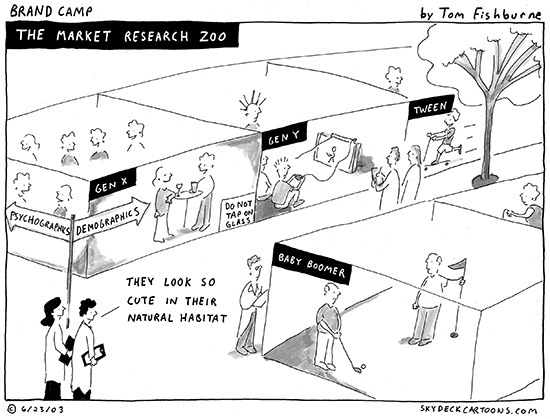
market research

Source: http://tomfishburne.com/2003/06/the-market-research-zoo.html
In the traditional form, target marketing had been done usually by demographics (age, sex, gender) and psychographics (lifestyles, activities, interests). The Internet has broken down the demographic and psychographic barriers. People are now coming together based on communities of affinity.
As highlighted by Seth Godin’s talk (http://goo.gl/jQhw1) the Internet has changed our world because it allows people to be connected. It has split the world up into a variety of different niches, from Ukrainian Folk dancers to Vegemite fanatics. It has allowed people to build emotional relationships with like-minded people. These relationships (like most) are based on the concept of trust; which for marketers, as we know, has decreased significantly.
It is relatively common knowledge in the marketing world that 30% of purchase decisions are rational, while 70% of purchase decisions are emotional. Demographics do not tell marketers how to reach people emotionally, or indeed physically. Sociographics do.
“We are not thinking machines that feel; we are feeling machines that think” – Antonio Demasio
What are Sociographics?
“Sociographics” or studying the social graph is a fairly recent phenomenon. On a basic level, this new way of targeting customers is to go after existing customers and find their friends.

The increase in sales to others that result from marketing to an influential customer is called the network value of a customer. Sociologists know that in any group, emotions ripple outward with the strongest concentration of emotion coming from the most powerful person in the room. So why can’t marketers use this approach in the online environment?

Awareness or adoption spreads from consumer to consumer through social networks, blogs, Internet chat & more recently, mobile phones, making words such as “trust”, “community” and “engagement” evermore important for digital marketers. Firms are now being able to use their websites to facilitate consumer-consumer advocacy via product recommendations or via online customer feedback mechanisms.

New forms of technology are allowing people to interact with each other more frequently and share information, values, and ideas. Early research has shown that marketing to people socially connected to an existing customer of a product has 3-5 times higher response rate to advertising versus traditional methods.


Peer-to-peer communication is now the way consumers get their news. The Internet has allowed companies to build individual customer profiles more easily. This will allow marketers to understand the values, needs and wants of potential consumers and help build customer loyalty. This can be done by targeted advertisements and personalisation.

Email : naturalseosolution@gmail.com | Mo : 8763723377 | Skype : sunmoon.mohanty

Sunday, 19 May 2013

What makes Coca-Cola the No-1 SuperBrand in Social Media?


Who else has completed more than 80 years of Olympic Partnership with largest-ever activation? Which brand has ever covered more than 275,000 miles across 186 countries in 365 days? Who gets the credit for activating a campaign that made fan cast nearly 910,000 votes, almost 7.3 million sabotages and accounted for virtually 3 million YouTube views?

cocacola1

Yes! You have guessed it right; Coca-Cola is the name that has registered millions of fan engagements. Coca-Cola leads all brands across the world in terms of social media impressions. This food and beverage MNC alone accounts for nearly 14% of the 10.6 billion impressions generated by the top 100 consumer brands, if survey reports by a credible source are to be believed. What makes it the #1 Brand in Social Media is a talisman in itself, an exemplary execution of social media marketing strategies to drive higher sales and tighter community involvement. Social media around the globe is filled with mentions of this brand. Coca-Cola is mentioned in over 9,500 blogs, 270 Facebook pages and around 1500 times on Twitter to recipe a powerful social media presence.

The mentions are generally about what’s going around in Coca-Cola with certain facts and its history. Over the years, this company has built a formidable follower base that responds to posts, tweets and blogs daily for optimum engagement.  You may ask that several other companies enjoy strong social media presence then why only Coca-Cola leads the chart?  Well read along to find what makes Coca-Cola the No-1 SuperBrand in Social Media.

Expertise to Engage

On Facebook Coca-Cola has around 62790856 likes with over 710909 talking about it and 400,000 followers on Twitter. The unyielding focus of this food and beverage giant on reaching people all around the globe via social media networks have accounted for such startling figures. Most of the campaigns for Coca-Cola are owned by fans and enthusiastic advocates of the brand. The posts on Facebook and Twitter are conversational, engaging and rarely have a promotional feel. In short, they know how to engage their audience. Their Facebook page is mostly run by fans and their opinions, videos, stories and photos are regularly updated for optimal community engagement.

Engagement Means More than Sales
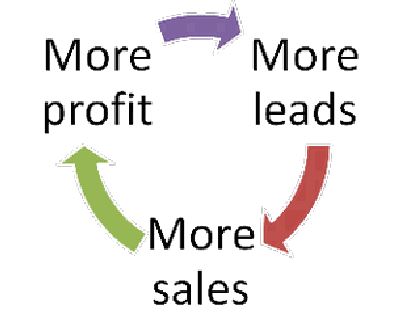
 more profit more leads

Is Coca-Cola earnest about its social media marketing? Yes! It is without doubt. Detailed study of recent social media trends through well-defined monitoring programs for better consumer-behavior insights and active participation has always been the basics of Coca-Cola’s blogs. The comments, queries and other feedback are highly valued and answered as soon as possible. Its social media strategy stands on the pillars of review, respond, record and redirect.

Again, small mention on the blogs breaks the ice to which followers respond and comments influx from all around the world. Coca-Cola’s highly imaginative approach of developing and uploading images, blogs, video vignettes and other meaningful applications make its blogs a wonder-house for social media marketing and engagement.

 Coca-Cola understands that Social Media marketing is more about community engagement than advertising as loyalty means more than sale. The art lies in understanding “What a Brand Stands For” and accordingly creating its personality on the social media promoting it across a variety of media. Even for a super brand like Coca-Cola continual quest to find new ways to engage fans is a must or else its stardom will quickly wear off.

Email : naturalseosolution@gmail.com | Mo : 8763723377 | Skype : sunmoon.mohanty

Tuesday, 14 May 2013

How Your Domain Name Will Impact SEO & Social Media Marketing

When starting a new website, one of the first and most important decisions you have to make is choosing a domain name. That choice will impact the website’s success in nearly every area, included search engine optimization (SEO) and social media marketing (SMM). Let’s examine how a domain name impacts SEO and SMM and then analyze the factors that make a good domain name.

Should I Choose A Keyword Domain?

For years SEOs and Search marketers have often purchased domains that contained their targeted keywords in order to increase CTRs and to help gain higher rankings on Google, Yahoo and other search engines. Let’s examine this strategy to determine if it is still effective.

Many SEO strategists would purchase exact match domains (EMDs), which are domains that exactly match the keyword phrase they are targeting. For example, if they want to rank for “buy green widgets” the person might purchase BuyGreenWidgets.com. EMDs offered two advantages.
  1. The presence of the keyword phrase in the domain was itself a ranking factor.
  2. The presence of the keyword phrase in the domain encouraged other webmasters to include
  3. The keyword phrase in the anchor text when linking to the site.
However, in light of recent Google updates (especially the “EMD update”), EMDs are no longer as helpful as they once were.
  • High Position’s study indicated that the “average EMD ranking went from #13.4 down to #26.6,” and the “average top 10 EMD went from #3.2 down to #11.9.”
  • SEOmoz data shows that EMD correlation with ranking has dropped from 0.34 in 2010 to 0.18 in 2012.
In light of the trend since 2010, many SEOs feel that EMDs and other keyword domains may become even less beneficial in the future. This does not mean that you should necessarily avoid or abandon keyword domains, but it does mean that keywords shouldn’t be the primary factor you consider when choosing a domain.

Keyword Domains For Increased CTR

In some cases, owning a premium keyword domain can increase click-through rates on ads and SERP listings:
  • A study published by Memorable Domains found that “ads featuring a generic domain name with an exact match to the product (ElectricBicycles.co.uk) performed significantly better than identical ads featuring an alternative generic (YourBikes.co.uk) or non-generic (InAHurry.co.uk) domain.” It is worth noting that YourBikes.co.uk looks very generic, and InAHurry.co.uk doesn’t appear to be relevant to the query. Sorry does this support the EMD or premium domain?
  • A study titled “How generic domain names impact SEM campaigns” shows that ads with the display URL DivorceLawyer.com achieved a 298% higher CTR than ads with the display URL VladimirLaw.com. However, this study was only based on 34 clicks, which is not enough data to accurately measure the performance difference.Sorry does this support premium domain or EMD?
  • Does the CTR advantage make buying a premium keyword domain a smart choice?
Consider these factors:
  • What is the search volume? Use Google’s keyword tool to find the exact match search volume for the keyword phrase the domain matches.
  • What is the cost? Most premium keyword domains are already registered and are difficult to obtain (read very expensive).
  • Is it a .com? For example, a keyword.info domain will be far less valuable than a keyword.com domain.
What Is More Important Than Keywords? Choosing A Brandable Domain

Having a domain name that matches your target keyword(s) does offer some benefits, but there is a bigger factor you should consider: the brandability of the domain.

Your brand is important, and your domain name is the foundation upon which your online brand will be built. Your domain name is how users will find, remember, share and identify your company online. In both social media and search engines, the domain name is the primary way by which users can identify to “whom” the link will lead.

facebook

While some marketers think that SEO is only about keywords and links, the reality is that Google likes brands. Google CEO Eric Schmidt once said that “brands are the solution, not the problem. Brands are how you sort out the cesspool. Brand affinity is clearly hard wired. It is so fundamental to human existence that it’s not going away.” The first step to building a brand is choosing a brandable domain.

7 Tips for Choosing A Brandable Domain

What is a brandable domain name? Start with these 7 factors to consider when choosing a brandable domain name.

Pick a .com extension. In most cases, .com is the best choice. This is because .com is the standard, the norm. Most users assume that a company’s website will end with .com; after all, 75% of all websites have a .com extension.

Be memorable. Users must be able to easily remember your domain name/brand. As Ashley Friedlein, CEO and Co-founder of Econsultancy, said, “Brand is the sum total of how someone perceives a particular organization.” You can only have a lasting influence on how people perceive you if they actually remember you.

Be relevant. Words have implicit meanings and connotations; do a little research to ensure that your domain name communicates your desired message. Here is a quick and easy way to test a domain name: go to Amazon Mechanical Turk and run a survey with at least 100 people. Just provide your domain name (nothing else) and ask users to guess the purpose of the company. The responses you receive should provide valuable insight into any implicit meanings your domain may connote.

Easy to spell. Your domain name must be easy to spell. Avoid commonly misspelled words, intentional misspellings and hyphens. If you purchase a domain name with numerals (eg 1widget.com), also purchase the domain name with the number spelled out (eg onewidget.com). Popular bookmarking site Delicious actually had to change its domain name because so many users had difficulties remembering how to spell it.

Sound authoritative. Your domain name should sound like a trustworthy authority. As this research brief puts it, users “demonstrate a clear preference now for credibility and trustworthiness in a domain name.” Remember Margaret Thatcher’s advice: “Being powerful is like being a lady. If you have to tell people you are, you aren’t.” Avoid choosing a domain such as bestwidget.com.

Shorter is better. Keep your domain name short; 1 or 2 words is best. The top 100,000 websites, on average, have 9 characters in their domain names.

Be unique. One of your marketing goals should be to build a distinct brand that stands out from your competitors. Start by choosing a unique and distinctive domain name. Names like YourDiscountInsuranceStore.com sound generic and unremarkable compared to names such as Google.com, Yahoo.com and Zazzle.com which sound unique.

How To Find A Great Domain Name

Choosing a domain name can be hard. In many cases the most obvious brandable domain names are already registered and would be expensive to purchase. Set up a brainstorm session with your team to develop a few ideas. If it helps, use these three formulas to brainstorm possible domain names.
  1. Use existing words. Amazon.com and VitaminShoppe.com are good examples of domain names that were created using existing words. Use a thesaurus to find words that may not readily come to mind.
  2. Create new words. Many famous websites are based on new words (or words that were so obscure that few people knew them). Examples include Google.com, Bing.com or Quora.com.
  3. Create portmanteaus. A portmanteau is a combination of two (or more) words or morphemes and their definitions to create one new word, like Groupon or Pinterest.
If you want more help brainstorming domain ideas, read this article on Ten Tools for Picking the Right Domain Name.


Email : naturalseosolution@gmail.com | Mo : 8763723377 | Skype : sunmoon.mohanty

Monday, 13 May 2013

10 Mistakes Every Startup Should Avoid When Optimizing for Search Engines


Search engines are still the number one place people turn when they want to learn something new or solve a problem. If you want your startup to attract and retain the level of attention it needs to survive, investment in SEO is a no-brainer. That said, SEO done poorly can end up doing more harm than good, and it’s easy to make mistakes if you don’t have the experience. Here are ten things to avoid if you want your startup to succeed in the search engines.

Mistake #1 – Poor/No UI and UX

It’s amazing how often webmasters still believe that you have to sacrifice the user interface and the user experience in order to get the best results in the search engines. If anything, this is the opposite of how search engines work today. Algorithm’s like Google’s Panda are designed to demote sites that offer users a poor experience.
Design always starts with the user. Search engines come second.
Test your interface by putting it in front of your users. Experience has taught us that the vast majority of users will interact with a website in the same way, and it only takes a small sample to figure out how most of your users are going to behave.

Mistake #2 – Slow Page Load Time

Do not assume that everybody has an internet connection like yours. Avoid the use of interfaces based on Flash and don’t use images or animations where text will suffice. This is especially important with the recent push toward mobile, where internet connections are much slower.
A large portion of your audience will leave if the site doesn’t load within a few seconds. You don’t have to sacrifice multimedia, but it should load last, and the site should be useable without it.
Don’t skimp on hosting. Nothing is more frustrating to a user than using high speed internet and still dealing with a website that loads as if it were on 56K.

Mistake #3 – Ignorance of Social Media

Even if all you cared about were the search engines (and what startup is that naïve?), you would still need to care about social media. The search engines currently use social signals as part of their ranking algorithms. While they still aren’t as important as links, social signals increasingly become a sign of trust that lends legitimacy to your other signals.
Mastering social media requires more than testing the placement of your social buttons. It requires the creation of content that demands to be shared, and regular interaction with your target audience. Interaction with social influencers is perhaps even more important.

Mistake #4 – Blog Content with No Value

The search engines are currently designed to evaluate how well a page solves problems for its users. It’s not a perfect system, as everybody who’s come across a spammy site knows, but it does tend to filter out the junk over time.
With every piece of content you create, you need to identify the problem it is attempting to solve, and make sure it solves that problem better than any other piece of content on the web. If you can’t do that, it means one of two things: you’re targeting saturated keywords, or you’re not investing enough in your content.
This is where it’s worth hiring outside talent. If you’re not knowledgeable enough about the subject, or don’t have the talent to portray it in the most helpful way, pay somebody with a proven track record. Hire somebody with a popular blog on the subject and leverage their reputation to bolster your own. This is what can really set you apart from the competition.

Mistake #5 - Targeting Search Engines Instead of Users

Hopefully you’ve already started to pick up on this message from the previous entries, but this subject is important enough to deserve its own subheading.
The days of keyword density are over, and they ended a long time ago. It’s amazing how often we still run into this misconception. If your keyword is in the title, and it’s what the article is about, you’ve already met your keyword requirements. Trying to impose any kind of artificial frequency on the use of the keyword just results in an article that looks like spam to anybody who reads it.
The same goes for optimized anchor text. Yes, if you can fit a variation of your keyword into the anchor text of a backlink, you should do this occasionally. But anchor text isn’t the holy grail of link building that it once was. In fact, over-optimized anchor text is a destructive force that can actually hurt your rankings or get you penalized. Focus on building links that get a click-through.
One of the most positive signals you can send to the search engines today is a repeat visitor. If a user searches for a term and clicks through to your site more than once, the search engines take this as a very positive sign, and happily send more users your way. This is one of the most underrated signals out there.
Monitor analytics to find out which pages see the highest returning visitor count. These are the pages you want to emulate with your future posts, and these are the pages most worth promoting.

Mistake #6 - Poor Site Architecture and URL Naming Convention

This is an especially easy mistake to make and it can be harder to get right than you might expect. Here are a few things you should try to avoid:
  • Multiple pages with the same or similar content – This one is especially problematic for ecommerce sites, since they often host a huge number of pages with similar content focused on different products. If possible, you want to alter the content so that it’s different for every product. This isn’t always possible, of course, and it can be extremelytime consuming. Another alternative is to simply noindex the pages with duplicate content so that Google doesn’t see it.  Yes, this will cut product pages out of the search results, but it will also prevent an algorithmic demotion.
  • Dynamic URLs – These can be a crucial part of some interfaces, but they can be very confusing for the search engines. Once again, you’ll want to make sure that your dynamic URLs are created in a folder that gets noindexed, or it can lead to massive duplicate content issues and confusion about which page to show in the search results. Create a single canonical URL for each piece of content and focus on promoting it. Noindex your dynamic URLs.
  • Meaningless URL Naming Convention – This is less of a problem than it was in the past, so if your site architecture is already built around garbage URLs, it’s actually counterproductive to go back and change them. However, in order to maximize benefit from the search engines, you will want to adjust the way URLs are built in the future. A good URL naming convention makes the hierarchy of the site clear, and makes it clear what each page is about.
  • Redirects – In general, you should avoid redirects when possible. Too many redirects tell the search engines that your pages are unstable and won’t stand the test of time. Redirects are sometimes unavoidable, of course, but you need to execute them properly. In almost every case, you should use a 301 redirect, not a 302 or 307. A 301 tells the search engines that the page has been moved permanently, and Google treats it like a link to the new page. A redirect always causes a drop in ranking power from the old page to the new one, however, so avoid using redirects when you don’t need to.

Mistake #7 - Not Claiming Google+ Authorship

Google+ is one of the less popular social networks, so it’s not uncommon for digital marketers and webmasters to wonder why it’s worth claiming authorship. This is a mistake, because Google+ is the social network that Google’s search engine has unfettered access to. Every interaction on that social network is monitored by the search engine, and Google can usually tell which accounts are run by actual humans by monitoring activity on their other properties like YouTube and Gmail.
Claiming Google+ authorship would be worth it even if it were just for one single benefit: a snapshot of your avatar right in the search results. By placing your image right next to your search result, Google+ authorship makes your search results stand out and appear more trustworthy. This inevitably encourages clicks and sends more traffic to your website.
Many speculate that authorship will eventually play a part in a concept called AuthorRank as well. AuthorRank would grant higher rankings to ages that were written by authors who have sent positive signals in the past, and possibly who display a great deal of activity and attract attention on Google+ as well.

Mistake #8 - Building Too Many Links Too Fast

Any strategy that allows you to build a large number of links yourself (or through automated software) is dangerous. This sends artificial signals to the search engines and it indicates that your link profile is being manipulated: that it’s unnatural. This can lead to swift penalties that hurt your traffic and damage your bottom line.
Don’t mistake this for a warning against using tactics that attract a large number of naturallinks in a short period of time. These strategies are totally above board, in fact, they are the best possible way to improve your search engines.
The question is where the links are coming from. Google frowns upon links that you build yourself. It’s as simple as that. In Google’s utopia, every link to your site would be completely natural, and nobody would point a single link to their own site ever.
This is clearly unrealistic, but it should help you understand how to approach link building. Just because a link is “hand built” this doesn’t mean that it’s a link Google wants to see. To protect your site for the long haul, you need to focus on building links that are defensible as marketing efforts.
The mantra I always use (and some of you may be sick of it by now) is “would I build this link if it were no-follow?”  If you wouldn’t, it means you are building the link purely to manipulate search engine rankings, and that means it’s strictly outside of Google’s terms of service. That’s true even if the content is high quality and everything else is done “right.”
By asking yourself this question, you can focus on building links that bring traffic to your site, and promoting content in places where it will attract natural links. This not only sends all the right signals to Google, it also assures that your marketing strategy will be a success even in the absence of search engine rankings.

Mistake #9 - Ignoring the Value of Content Marketing

Content marketing is the art and science of attracting attention and building trust with content alone. It’s about promoting your content in places where you can expand your reach, and retaining customers with content that keeps on giving. This means that you expand the benefits of content beyond pure SEO, start embracing the power of social networking and email marketing, and you start thinking about guest posts and other collaborations as an opportunity to send referral traffic to your site.
It also means that you start to place a bit less emphasis on site traffic, and a bit more emphasis on brand impressions. Several studies suggest that brand impressions influence sales more than clicks do, and this should influence your approach. Clearly, it’s always better to have impressions on your own site, where the data is more easily measured and you have full control of the message, but if you focus too much on site traffic you will lose the opportunity to increase impressions elsewhere.
Finally, content marketing means learning about how viral promotion works, and what makes people want to keep passing along a piece of content. Viral promotion is one of the most important ways to expand your reach, although it’s important to ride the right balance between reach and relevancy. Also, it’s important to recognize that customer retention is just as important as expanding your reach, and the approach to each goal is different.
We cover content marketing extensively in this guide.

Mistake #10 - Hiring the Wrong SEO Agency

It’s almost always better to hire an SEO agency than to try to do the promotion on your own, but choosing the wrong agency can be even worse. We recently discussed 20 questions to ask an SEO agency before working with them, and here are a few takeaways from that post:
  • A firm should have some contingency plan or compensation if they fail to provide results or drag you through a penalty.
  • The firm should have some unique selling proposition that sets them apart from other SEOs.
  • They should be transparent with you and the SEO community about how they do business.
  • They should rely primarily on tactics and strategies that will work no matter how much the search engines change.
  • It should be clear how they plan to make you an industry authority when they, as SEOs, are not experts in your industry.
  • They should have strong outreach and relationship building skills.
  • They should share results of previous successes.
  • You should play an important part in the process.
Check out the link above to learn more. The important thing to remember is that SEO done poorly can actually do more harm than good, so treat it the way you would approach an investment in the stock market.
Email : naturalseosolution@gmail.com | Mo : 8763723377 | Skype : sunmoon.mohanty

Wednesday, 8 May 2013

Can Social Media be Your Primary Marketing Strategy?


It is no secret that social media is turning into quite the process. It’s becoming more and more important, so many different tools and advice columns keep popping up to help businesses and individuals stay organized and successful when it comes to this newer marketing effort. This has caused many companies to create a full-time social media position for experts to help manage the many social accounts, follow analytics, get creative with engagement, etc. It takes a lot of time and effort, but the payoff is only increasing as social involvement increase, so it’s easy to ask yourself: Can I get away with making my social media strategy my primary marketing strategy?

The Defense: A Case for a Social Media Marketing Strategy

No matter what your reasons are for putting all of your energy and resources into social media marketing, most are always thinking about the scenarios in which this idea might actually work. Below are a few instances where this strategy could potentially show success:
  • If you have a very small budget. 
Those who ask this question are typically small businesses on a budget, and rightfully so. Social media is one of the most inexpensive ways to get the word out there about your business. Although a company may have to pay an expert or a team of experts to make it happen (after all, if this is your primary method you want to be present on every single account from StumbleUpon to Quora to Slideshare), that’s the price that you pay for any marketing efforts you adopt. The only difference here, however, is that this will likely still be the least expensive.
  • If your company targets an audience that is very active on social media.
While you might miss out on opportunities by neglecting other marketing strategies, you can still earn success (and save money) if you know that most of your audience is active on social media. If you have done enough research to know that your product or service resonates well with this age group, and you know that some of your past clients and customers found you on social media or find other companies via social media, you have yourself a good outlet.
  • It can be targeted and easy to find analytics.
Social media is easy to target because social networks have so much specific information about its users (most of this information voluntarily given to the networks by the users). When it comes to buying ad space on a site like Facebook, you can make sure that you’re targeting to those in your audience the same way you would with buying ad space on a search engine like Google (this is a huge advantage for companies that have found the first two points to be true; otherwise you might be better off with Google). Most of the major social networks such as Facebook and Google+ also have built in analytics to help you determine which posts are getting the post traction and the demographics of those in your network.

The Prosecution: Why Even A Small Business Needs More than Social Media Marketing

The prosecution has tons of statistics on its side. A few reasons why you might need more than just a social strategy include:
  • Plain and simple, more visitors come from search than social media.
According to a previous Search Engine Journal post, a study by Outbrain showed that search is the number 1 driver of traffic to content sites, beating social media by more than 300 percent. Every site needs traffic, and it seems that search is the place to really find it.
  • It isn’t as successful when it comes to conversions.
Social media is wonderful for visibility and engagement, but it’s harder to draw leads from social media as opposed to SEO. People use social media to socialize, but they use search to discover new things at a time when they are ready.  A Search Engine Watch article details a study that surveys users about when they use search and when they use social to gain information, and the only time social prevailed was when talking about “discussion.

The Verdict: A primary strategy works well, but it rarely works as your only strategy.

So this might seem like a lazy answer, but let me explain. Social media can be your primary marketing strategy, but it’s best to think of it only as the primary strategy for certain things. For example, it might very well be your primary marketing strategy for building your individual brand. It might very well be your primary strategy as a startup looking to save money. It might be your primary strategy when you are targeting a younger demographic (which might be the majority of the time). It’s all about what you’re focusing on at a given moment.

So what about social media marketing being your only strategy? It seems as though it would work in certain instances, but you simply can’t discount the fact that your business is going to change and have more needs as it develops. In other words, social media marketing can definitely be an overall primary strategy for some, but it shouldn’t be the only strategy used to sell your product or service. The prosecution wins this one, but not by a lot.

Do you think that a business could be successful if they employed social media marketing as their primary way to market the company? Are you a business that has succeeded or failed when attempting this idea? Let us know your story and your thoughts in the comments below.

naturalseosolution@gmail.com | Mo : 8763723377 | Skype : sunmoon.mohanty

Tuesday, 30 April 2013

Six Interesting Facebook Tricks You Might Not Know


At this point, you are all probably pretty familiar with Facebook, and some of the more common features like updating statuses, checking-in, browsing profiles, pages, and apps, and many more day to day actions.
However, most people are not aware of a number of interesting, but mostly useless, tricks and hacks, which you can perform on Facebook today.
Here are 6 of our favorite useless, but interesting, Facebook tricks and hacks for you try:

Modifying Anchor Text of a Target Page’s / Profile’s URL

SEJ 1
Image courtesy: https://www.facebook.com/wittykittymi/posts/10151430928688218

The Trick:

By default, Facebook allows us to tag profiles & pages using the “@” symbol on our status updates.
But with this hack, you can modify the anchor text that is used to link to your profile or page.  If you notice, this status update contains text links “THIS PAGE”, “TODAY I LEARNED” & “facts”, all linking to the URL https://www.facebook.com/todayilearn.

How to do it:

SEJ 2
1) To get your page’s/profile’s ID, you can go to findmyfacebookid.com & type in the URL of the page or profile you are interested in.
SEJ 3
2)  Once you have the numeric ID, copy this code to create the link in your updates.
@@[0:[YOURPAGEID:1:YOUR PREFERRED ANCHOR TEXT]]
Note: The code has to be in the status update TWICE, otherwise, linking won’t work.
Hence, in the above post, the exact post should be entered as:
“When was the last time you visited @@[0:[342422379172885:1:this page?]]
“LIKE” @[342422379172885:0] for awesome @@[0:[342422379172885:1:facts]]!”

Removing Your Last Name in Your Facebook Profile

SEJ 4
Image source: https://www.facebook.com/wittykittymi

The Trick:

As part of Facebook’s security checks, you are required to completely fill out your account details to successfully create an account. By default, Facebook requires every user to enter their full name prior to saving their profile settings.
With this trick, you will be able to bypass Facebook’s restrictions and drop your last name.

How to Do it:

1) Open Mozilla Firefox (Firefox is required for this hack to work)
2) Go to Options -> Advanced -> Network -> Settings -> Connection Settings -> Manual Proxy Configuration
3) In the HTTP Proxy Field, enter 103.10.62.30, port 8080, or use any Indonesian Proxy.
SEJ 5

4) On your facebook profile, go to Account settings — > Change Language to BAHASA INDONESIA
5) Remove your middle name & last name.
SEJ 6


Adding Animated Custom Tabs

SEJ 7
Image Source: https://www.facebook.com/TriviaManiaOfficial

The Trick:

Facebook doesn’t allow users to upload animated GIFs anywhere on the site, so if you wanted to have an animated GIF somewhere, you’re out of luck, unless…
There is a trick that allows anyone, who has the following resources, to bypass this limitation in uploading animated GIFs for custom tabs.

How to Do it:

1)       You must have Adobe Photoshop C5 & Quicktime Player.
2)       Select the animate GIF you want to upload.
3)       Open Adobe Photoshop CS5 and go to File > Import > Video frames to layers. In the File Name box, just enter *.* as your filename and choose your GIF image.
4)       Resize your GIF to 111 x 74 pixels to fit the custom tab image .
5)       Save your file in a PSD format. Check the save option, ‘LAYERS’

Creating Your Own Emoticon on Facebook Chat

SEJ 8 SEJ 9

The Trick:

While this is not actually new, many people have no idea about this feature. Since 2011, Facebook has allowed users to chat with their friends using custom emoticons, and now you can too. Just by getting a page’s or a profile’s ID or username, Facebook will let you use their profile pictures as your chat emoticon in thumbnails…
*note this only works in the Facebook Chat and not in updates. 

How to Do it:

1)       Go to any profile, official Page, or event that you want to use as an emoticon.
2)       Look for the profile ID at the end of the URL, such as “Mcdonalds” from https://www.facebook.com/McDonalds
3)       Place that username or number in double brackets like [[Mcdonalds]]
Note: Pages with no username /vanity URL  e.g https://www.facebook.com/McDonalds have default ID numbers displayed on their URLs (https://www.facebook.com/pages/Socially-Awkward-Penguin/98438140742).  So when you cannot find  a profile or a page’s username, just refer to the numbers at the end of the URL, instead. 
4)       Enter that into a Facebook Chat or Message field.
Rage Faces IDs:
Here is a collection of a few rage faces courtesy of Reddit.
Using Profile IDs
Troll face: [[171108522930776]]
Are you f****** kidding me : [[143220739082110]]
Not bad Obama: [[169919399735055]]
Me G usta: [[211782832186415]]
Mother of God: [[142670085793927]]
Cereal Guy: [[170815706323196]]
LOL Face: [[168456309878025]]
NO Guy: [[167359756658519]]
Yao Ming: [[218595638164996]]
Derp: [[224812970902314]]
Derpina: [[192644604154319]]
Forever Alone: [[177903015598419]]
F yeah: [[105387672833401]]
Challenge accepted: [[100002727365206]]
Okay face: [[100002752520227]]
Dumb bitch: [[218595638164996]]
Poker face: [[129627277060203]]
Okay face: [[224812970902314]]
Socially awkward penguin: [[98438140742]]
No: [[167359756658519]]
MOG: [[142670085793927]]
Like a sir: [[168040846586189]]
Using Usernames / Vanity URL
Not Bad: [[NotBaad]]
Rage face: [[FUUUOFFICIAL]]

Making Your Profile Photo Un-clickable

9


The Trick:

Not everyone really wants to have their header image clickable, but yet that’s the way Facebook header images work, or do they? Well, if you’re curious, you should give this one a try:

How to Do it:

1)       Go to your Albums – > Profile Pictures
2)       Select your current profile picture.
3)       Adjust privacy setting to “Only Me”

Selecting / Inviting All Friends

se

The Trick:

Selecting & inviting all of your friends in an event can be a tedious task, especially if you have more than 1,000 friends to send invitations to.
Luckily, this trick that allows users to select/invite all of their friends in an event or an app – with just one click.

How to Do it:

1)       Open Firefox and go to your Facebook page to invite all friends to like your page.
2)       Select “All Friends” instead of “Recent Interaction” so that you can invite all friends to your page. Scroll down till all of your friends are shown in the page.
3)       Press Ctrl+Shift+K and a small window will appear at bottom.
4)       Paste the below code in it and click enter.
javascript:elms=document.getElementsByName(“checkableitems[]“);for (i=0;i < elms.length;i++){if (elms[i].type=”checkbox” )elms[i].click()};
Hacks and Tricks like the above, should always be attempted using caution. We are not aware of anyone ever getting in trouble for using the above Hacks, but in some cases they do bypass the intended functionality of Facebook, so be careful.
Which of these tricks is your favorite? If you have any Facebook tricks you would like to share, please let us know in the comments!

Email : naturalseosolution@gmail.com | Mo : 8763723377 | Skype : sunmoon.mohanty

Monday, 29 April 2013

How Social Media is Changing the SEO Industry


It is painfully cliché to talk about “the rise of social” and “the power of social media.” That happened a long time ago. Now it’s settled, and we can make some real progress.
The power of social lives on beyond its ubiquity, and wields a transformative impact on SEO. Please understand that I’m not going to propagate any myths about how to increase your rankings via social media. Nor am I going to propose that SEO-is-dead-so-long-live-social. Instead, I’ll attempt to demonstrate how social is infringing upon the traditional realm of SEO as a major factor in how people find information, convert, and interact with the Internet.

The argument over the correlation of social likes and search rankings is moot. 
First, social likes are important. Their impact upon search rankings, however, is not relevant to this discussion.
Bloggers and pundits love to discuss the search ranking value of an active social presence. “Do Facebook ‘Likes’ Increase Search Rankings,” asks one author. (Her answer, interpreted:  ”Uh, we’re not sure.”) Groupon explains “How to Improve Your Search Rankings with Social Media.” Others croon that Facebook comments can improve one’s rankings.
There’s little value in debating such claims. The studies are inconclusive. What we need to do now is determine what real changes have taken place that actually affect searches.
Social Factors That Impact SEO
Keep in mind that SEO is alive and well. Yet along with the continued impact of SEO is the increasing dependence upon social for how people search, find, and respond to information. Here are the major factors that are forming this social search trend.
1.    Personalized search results.
By default, Google returns results that are most relevant to you personally, assuming you are logged in to a Google account. If you look in the upper right corner of your search results page, here’s what you’ll see:
personalization
The icon circled in red indicates that your SERP is “currently showing personal results.” Clicking the globe icon will “hide personal results.” Personal results dish up all the general content that correlates with your search, but will also show “pages, photos, and Google+ posts from your friends,” according to Google’s explanation. Google personalizes search results in order “to deliver you the most useful, relevant content for your search.”
When I searched for “Google authorship,” I returned a list of results, including this one:
google authorship
See the circled icon? That informs me that this is a personalized search result. Search Engine Land is in my Google Circles. Thus, they get position number five on my personal SERP, and are denoted by the image.
Personalized results have a huge impact for real life. If you search for a lawn care company, you’re likely to return top-ranked results that your friends have +1ed. If you look for pictures of “horses” and your friend has photos of her appaloosa on her Google+ account, that’s what will top the list of pictures.
Larry Magid bemoans personalized search results in his Huffington Post article. He bases his complaints on “privacy and antitrust concerns” and “biased results.” He has a point: “It kind of ruins what Google spent so many years building.”
Hate it or love it, personalized search results mean that search engine optimization loses influence. Instead, personalized search factors bear heavily upon which returns feature prominently in your results.
You can thank social for this massive change in how SEO works.
2.  Anything “viral” is social. 
Everyone has felt the impact of viral content, clips, or trends. Admit it — you watched Gangam Style, along with more than 1.5 billion other people.
The whole viral trend is built on the power of social media. Nothing goes viral unless it is “shared,” and nothing is shared unless it happens via social media.
You simply can’t pull off a viral trend by performing some SEO tricks. It has to be social.
3.    The Social Foundation of Local Search
Local search has experienced a radical transformation since the advent of Google Places and Yahoo! Local. The results delivered by these sites are built upon social interaction and the weight of social profiles, whether business entities or individuals. From Facebook check-ins, to Yelp ratings, to Foursquare interaction, local search depends heavily upon social involvement.
4.    The Impact of Google+ 
Google+ is a game changer. I’ve already mentioned how personalized search results are determined based on who posts what in your circles. There are other major changes besides.
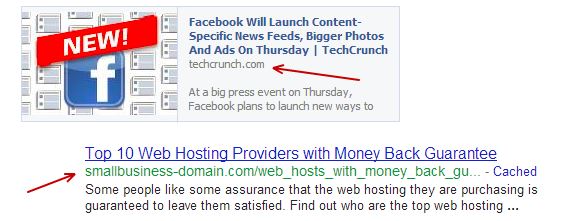
Let’s take one example. Google results now show the picture of the author next to the content. You’ve probably seen search results that look like this:
authorship markup
Those smiling mugs get a 150% increase in click-through rates over their non-pictured counterparts according to Catalyst. It pays to be seen. In other words, it pays to be active on social networks like Google+. That’s where these pictures originate — a bit of rich snippet wizardry and Google authorship verification on Google+.
Google+ is the single most powerful social force on the Internet today. Facebook may have a bigger market share, but Google+ has a bigger ownership of search power. Facebook doesn’t write the algorithms; Google does.
What’s more, Google+ isn’t just a social network; it’s a personalized web experience that extends to your every interaction with Google products. The persistent Google navigation bar keeps you constantly in tune with a personalized web experience:
google nav bar
This means that you’re never more than a click away from the social spin on whatever it is you’re doing.
5.    Social network searches
Much of our interaction with the web comes through our social channels. In addition to Googling, you’re also visiting sites by means of the following methods:
  • Clicking links that your friends post on Facebook
  • Viewing Tumblr accounts
  • Clicking all those bit.ly links on Twitter, even though you don’t know what they link to
  • Checking out articles that have been +1ed by people in your Google+ Circles
Web users spend a lot of time on social media. Their engagement with the web is built on how they interact with their social circles. Data from one social media research project in late 2012 revealed that 18% of the time spent online is spent on social media.
Often, rather than search for a site on Google, people will search for a site’s social profile. A Facebook business page provides excellent at-a-glance results for a local establishment’s business hours. In fact, it’s way better than navigating to the business website, tracking down the information, and hunting for the business hours. The Facebook page instantly shows the business hours.
One of the most powerful effects of a social network is the way it transforms customer decision-making. Search Engine Land’s 2012 study stated, “72% of consumers trust online reviews as much as personal recommendations.” More than half of consumers agreed that positive online reviews increased their likelihood of using a local business. E-consultancy declares that 88% of customers will consult reviews before finalizing an online purchase. Even conversion rates are affected by social.
Again, social media is jostling with SEO for dominancy in how people find what they’re looking for, and how they make their decisions.
Mail Us : naturalseosolution@gmail.com | Ph : 8763723377 | Skype : sunmoon.mohanty