Showing posts with label Unsuccessful Link Building. Show all posts

Sunday, 19 May 2013

Three Killer (and unfortunately most ignored) Link Building Ideas


Let’s face it: authorship may have been bulldozing around for quite a while, but links are the most important ranking factor for search engines, still. SEOs are still buying links for their clients. High-authority sites are still selling do-follow sponsored links – Forbes was recently penalized for that (note, it’s been penalized in the past too); Search Engine Roundtable was also penalized doing the same (amazingly, Barry surrendered to Google this time around and no-followed all the sponsored links on his site). These are some of the many sites we know – yet there are many out there that’re selling links secretly.

Buying links is not as bad a practice as it sounds today – even the great SEO authorities like Danny Sullivan and Rand Fishkin supported it once – but Google wants us to have natural links only and is going out of its way to catch the transgressors (by looking at patterns, site history etc). And as Google’s search algorithm gets smarter and smarter – it’s now even tricking spammers by faking search results for a short time – it makes little sense to buy sponsored links even if the site owner promises to make that sponsored thing unlabeled.

Let’s discuss three killer link building ideas that’re also unfortunately the most ignored, for sooner or later we need to reach to a stage where we build some genuine relationships and stop fretting over what if Google gets to know about this.

Forget keywords as anchor texts

Let me first speak your mind: “here’s another noob to SEO,” “it’s easier said than done,” “wait, come again!” “horseshit!” … Ok, I understand that I might not sound irrefutable when I say forget keywords as anchor texts. But do you remember Google Penguin? Yes, the update that’s getting more and more intolerant to link spamming over time and would now penalize you even if 80% 50% of your links are suspicious.

“How would I rank then”, you ask? First, we need to make it clear that Google doesn’t hate anchors – Google loves them, read its SEO guide for starters again. Anchors are one the best ways to help Google “organize the world’s information and make it universally accessible and useful”. Google actually hates webspam. It’d undoubtedly benefit you if you’ve diversity in your anchors and are not over optimizing them. Use your company’s name as anchor text because that’s most natural – you can at times use your URL and at the other times your keywords as well. And hey, if you’re contributing a guest post, you could even link to some of your cool stuff anywhere in it, but, of course, that should be terribly relevant.

It’s not about links, it’s about you, your business, and your brand

As SEOs, we’ve always been obsessed with links. Whenever there is a talk about SEO, most of us fascinate links from sites like Mashable, TechCrunch, Smashing Magazine, SEOmoz and even Search Engine Journal. That needs to change. Links-first approach needs to change to business-first approach, or rather relationship-first approach.

It takes time and effort for high-quality link building practices such as creating infographics, guest posts, podcasts, webinars and comics. And it’s not justifiable to belittle all that to links only. Let me explain.

Suppose you have contributed a guest post to a high-authority tech blog (say, example.com) and got your golden link. You’re, of course, excited as hell but are now shifting your attention to another great blog, another golden link. You’re now thinking in domains – one domain, one link. That’s good, but only for your link portfolio. Moreover, did you thank example.com for publishing your post? Did you even entertain the comments on your post? Did you try to push your post on social media? These are some of the things we need to take care of if we want to build relationships for life. And trust me, links will follow.

If you’ve walked uphill bare foot to get a link, Google knows that

If you give a choice to choose between 500 links from low-quality sites and one from Huffington Post, I’ll choose the latter. Why? Because numbers don’t matter anymore to search engines. Only quality and relevance do. And don’t worry, Google would sooner or later find out whether your link is hard-earned or not.

Conclusion

It’s better to stop obsessing over links and SEO. When we do that, we end up doing disasters, spamming. Let’s not over optimize links anymore, because letting them look as natural as they would help us in the long run, too. Let’s seek hard links, build happy relationships and help our clients do that.
Email : naturalseosolution@gmail.com | Mo : 8763723377 | Skype : sunmoon.mohanty

Tuesday, 14 May 2013

A Beginner’s Guide to Unsuccessful Link Building


So you’ve built as many links as it is humanly possible to do. All the links have good anchor text, are well positioned and are placed on decent sites. Job well done.

As you head to the office the next day you anticipate a fanfare of trumpets, lavish gifts and perhaps even a throne. All because web traffic has quadrupled overnight, domain authority has hit a record high and sales are through the roof.

In reality though, you are sent crashing back down to Earth. Traffic continues to plod along as usual, completely indifferent to your efforts, whilst the unchanged domain authority and sales figures, merely mock the hope that is slowly fading from your eyes.

Alas my friend, that is as good a sign as any that your link building strategy needs some work. It could just be a bit of tweaking or it could be a full blown overhaul (fingers crossed for the former).
Have no fear though, because below are 11 reasons why your link building isn’t working and a few tips on how to stop it from…well…not working!

All you need is a little patience

In the world of SEO it can sometimes take a little while for things to take effect, so before doing anything rash I recommend patience. There isn’t much you can do to speed it up anyway – after all Google doesn’t really like people telling them what to do.

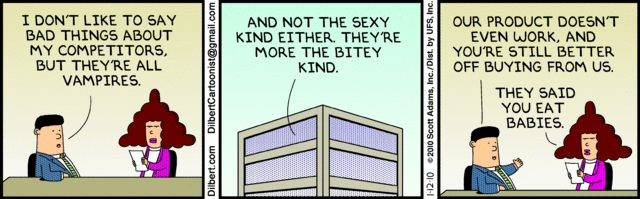
Your competitors are making you suck

If you need a scapegoat for the poor performance of your links look no further than your competitor. Granted that’s probably not the right attitude, but the excuse still stands…kind of.


dillbert comic

If your link building strategy isn’t going as planned then it could just be down to your pesky competitor’s strategy being better. If that’s the case then be prepared to out think, or out spend (not by buying links of course), in order to get a foot up.

Occam’s razor

Often the simplest, and most obvious, theory is the correct one. It is easy to overlook simple mistakes that are having a negative effect on your link building strategy. This is why, once you have a guest post, infographic or whatever piece of content you’ve used published, it is always worth going back to the site to have a look. This way you rule out any silly mistakes like typos in the url, anchor text or even no link at all.

Panda got your tongue?

From time to time you’ll find that your rankings may drop or your links may lose value for no obvious reason. This could be down to a number of reasons, but one of the first things you could check for is any algorithmic updates. These usually aren’t too difficult to find out about although there are rumours that Google will no longer broadcast or confirm their algorithmic updates. Once found, you will hopefully be able to identify the reasons for the recent drop in rankings etc.


panda

Your links aren’t as good as you thought

Now I’m not in the counsels of the great at Google, which is why I don’t profess to know how their algorithm works. However, if you were under the impression that you had authoritative sites linking to you but see no improvements in rankings, domain authority etc. It may be time to rethink where you’re trying to get links from/placing links.

Be original

If your link building campaign is based on using duplicate, or spun, content odds are you’re getting links from low quality, half spammy, sites which may, at least partially, explain poor results.

Onsite issues

Your link building campaign might not suck just because of your links. It is possible that there are other factors at work on your site that are damaging your offsite efforts. For starters check Webmaster Tools to see if Google have sent you any messages or issued any warnings. I’d also suggest running Screaming Frog to see if there are any broken links or site errors that could be affecting your link building. After all if you’ve been building loads of links to a page that has a 404, then it’s no wonder that you aren’t getting much joy.

Irrelevant site or content

As a general rule getting a link on a site that has little or no relevance isn’t particularly useful to a link builder. Although it will probably still pass link authority it is unlikely to help in achieving other aims such as increasing web traffic and conversions. Obviously if a really high profile site offers you a link then don’t turn it down, but be wary of having too many irrelevant sites pointing to yours.

Co-citation

This is a relatively new concept in SEO, but the esteemed Rand Fishkin boldly predicted that co-citation’s present influence – which is relatively small – will increase in the next few years. For those who don’t know what co-citation is I’ll explain it very briefly. In SEO, co-citation refers to the effect the content surrounding a link/keyword/brand has on SERPs. For example if Company A is a bakery and they keep getting mentioned/linked to in articles about cakes in London etc, then it may not be a surprise to see Company A sneak up the rankings for those, and other related, search terms. Why? Because Google has picked up that Company A is commonly associated with cakes etc and therefore believes it is a relevant result to show up for people using the appropriate search terms.

Interlink your content

It is important to try to interlink your content/website. For example if I’m writing an article on Site A and I remember that a few months ago I wrote an article that covers something relevant on Site B. Then it’s best practice to include a link from A to B so the link authority passes from one to the other; all whilst providing a legitimate link for users. As with most SEO tactics interlinking, or horizontal linking, is open to abuse and manipulation; so don’t go crazy and link to every site you’ve ever heard of in a 300 word post about apples.

DA isn’t the be all and end all

Link builders beware of domain authority. Although it is a great indicator of how Google sees a site’s authority it should be viewed with caution when it comes to link building. Mainly because it doesn’t take a site’s traffic, social metrics and user interaction into account. But just because SEOMoz doesn’t, it doesn’t mean you can’t – after all you can see, and qualify, things that no crawler can. Or if you don’t want to do it Inkybee is a relatively new tool that helps link builders to qualify a large number of websites at a time – think Buzzstream on steroids.

Email : naturalseosolution@gmail.com | Mo : 8763723377 | Skype : sunmoon.mohanty