Showing posts with label What is Google Panda. Show all posts

Tuesday, 14 May 2013

A Beginner’s Guide to Unsuccessful Link Building


So you’ve built as many links as it is humanly possible to do. All the links have good anchor text, are well positioned and are placed on decent sites. Job well done.

As you head to the office the next day you anticipate a fanfare of trumpets, lavish gifts and perhaps even a throne. All because web traffic has quadrupled overnight, domain authority has hit a record high and sales are through the roof.

In reality though, you are sent crashing back down to Earth. Traffic continues to plod along as usual, completely indifferent to your efforts, whilst the unchanged domain authority and sales figures, merely mock the hope that is slowly fading from your eyes.

Alas my friend, that is as good a sign as any that your link building strategy needs some work. It could just be a bit of tweaking or it could be a full blown overhaul (fingers crossed for the former).
Have no fear though, because below are 11 reasons why your link building isn’t working and a few tips on how to stop it from…well…not working!

All you need is a little patience

In the world of SEO it can sometimes take a little while for things to take effect, so before doing anything rash I recommend patience. There isn’t much you can do to speed it up anyway – after all Google doesn’t really like people telling them what to do.

Your competitors are making you suck

If you need a scapegoat for the poor performance of your links look no further than your competitor. Granted that’s probably not the right attitude, but the excuse still stands…kind of.
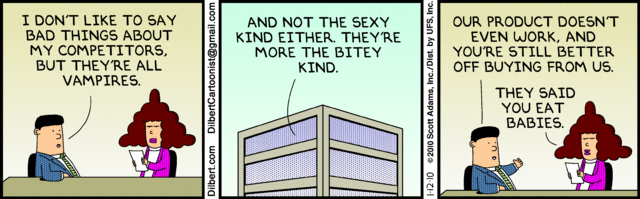

dillbert comic

If your link building strategy isn’t going as planned then it could just be down to your pesky competitor’s strategy being better. If that’s the case then be prepared to out think, or out spend (not by buying links of course), in order to get a foot up.

Occam’s razor

Often the simplest, and most obvious, theory is the correct one. It is easy to overlook simple mistakes that are having a negative effect on your link building strategy. This is why, once you have a guest post, infographic or whatever piece of content you’ve used published, it is always worth going back to the site to have a look. This way you rule out any silly mistakes like typos in the url, anchor text or even no link at all.

Panda got your tongue?

From time to time you’ll find that your rankings may drop or your links may lose value for no obvious reason. This could be down to a number of reasons, but one of the first things you could check for is any algorithmic updates. These usually aren’t too difficult to find out about although there are rumours that Google will no longer broadcast or confirm their algorithmic updates. Once found, you will hopefully be able to identify the reasons for the recent drop in rankings etc.


panda

Your links aren’t as good as you thought

Now I’m not in the counsels of the great at Google, which is why I don’t profess to know how their algorithm works. However, if you were under the impression that you had authoritative sites linking to you but see no improvements in rankings, domain authority etc. It may be time to rethink where you’re trying to get links from/placing links.

Be original

If your link building campaign is based on using duplicate, or spun, content odds are you’re getting links from low quality, half spammy, sites which may, at least partially, explain poor results.

Onsite issues

Your link building campaign might not suck just because of your links. It is possible that there are other factors at work on your site that are damaging your offsite efforts. For starters check Webmaster Tools to see if Google have sent you any messages or issued any warnings. I’d also suggest running Screaming Frog to see if there are any broken links or site errors that could be affecting your link building. After all if you’ve been building loads of links to a page that has a 404, then it’s no wonder that you aren’t getting much joy.

Irrelevant site or content

As a general rule getting a link on a site that has little or no relevance isn’t particularly useful to a link builder. Although it will probably still pass link authority it is unlikely to help in achieving other aims such as increasing web traffic and conversions. Obviously if a really high profile site offers you a link then don’t turn it down, but be wary of having too many irrelevant sites pointing to yours.

Co-citation

This is a relatively new concept in SEO, but the esteemed Rand Fishkin boldly predicted that co-citation’s present influence – which is relatively small – will increase in the next few years. For those who don’t know what co-citation is I’ll explain it very briefly. In SEO, co-citation refers to the effect the content surrounding a link/keyword/brand has on SERPs. For example if Company A is a bakery and they keep getting mentioned/linked to in articles about cakes in London etc, then it may not be a surprise to see Company A sneak up the rankings for those, and other related, search terms. Why? Because Google has picked up that Company A is commonly associated with cakes etc and therefore believes it is a relevant result to show up for people using the appropriate search terms.

Interlink your content

It is important to try to interlink your content/website. For example if I’m writing an article on Site A and I remember that a few months ago I wrote an article that covers something relevant on Site B. Then it’s best practice to include a link from A to B so the link authority passes from one to the other; all whilst providing a legitimate link for users. As with most SEO tactics interlinking, or horizontal linking, is open to abuse and manipulation; so don’t go crazy and link to every site you’ve ever heard of in a 300 word post about apples.

DA isn’t the be all and end all

Link builders beware of domain authority. Although it is a great indicator of how Google sees a site’s authority it should be viewed with caution when it comes to link building. Mainly because it doesn’t take a site’s traffic, social metrics and user interaction into account. But just because SEOMoz doesn’t, it doesn’t mean you can’t – after all you can see, and qualify, things that no crawler can. Or if you don’t want to do it Inkybee is a relatively new tool that helps link builders to qualify a large number of websites at a time – think Buzzstream on steroids.

Email : naturalseosolution@gmail.com | Mo : 8763723377 | Skype : sunmoon.mohanty

Monday, 29 April 2013

How To Recover From Google Panda Update


Google’s Panda update, aimed at improving the quality of search engine results, has left webmasters reeling under shocks. Naturally, the sight of plummeting traffic is nothing short of shocking!
However, Panda is not just a ruthless body blow to domains, but a lot more. And understanding it in totality is the first step towards standing through the storm like an oak.
google panda logo

Do you need to be worried?

If you rear any thoughts of success with your websites, you should be concerned. A good way to begin the analysis of how Panda affected your website would be to assess whether your traffic influx improves, remained stable, or dipped.
Party hard if you experienced improvement, the future is yours. Stay in your boots if no significant change occurred, but be careful. Traffic down? Get down to serious work, now is the time to act.
If you want to know if  your website/blog is affected with Google Panda or not, then you need to cross check with your traffic analyzing tools like Google Analytics, awstats, histats and so on. Observe the traffic tread on the day before and after panda update.

What does Google Panda aim to target?

At the receiving end of the algorithm update from Google are websites which:-
  • Serve you useless content, in other words thin content.
  • Work as content farms.
  • Clutter loads of ads on pages.
  • Are designed recklessly.
  • Remain stuck without updated content for long durations.
  • Have useless pages indexed in Google.

How can you control the damage and survive the Panda updates?

Arguably, the most important bit of information you could gather about the Panda algorithm update is – it can be survived! That’s true. The following tricks, if done in the right vein, are guaranteed to have you smiling through these testing times with Google’s search algorithms.
  1. Get rid of stinky content – If Google could engrave ‘Content in King’ in titanium and affix on the desk of every writer, blogger and webmaster, it would do! Panda is another step towards kicking away websites with less than valuable content. So, even if you have a couple of pages with low quality content the Panda update would penalize the entire domain; either improve or throw them away.
  2. Get into your viewers’ shoes, and bellies – Design for the user, do away with crazy designs that impair the readability and visibility of content.
  3. Break broken links – Nothing irritates viewers more than 404 error pages. Apparently, Google is getting equally irritated now that Panda is on. So, use efficient tools like Xenu Tool to fix all broken links.
  4. See ‘duplicity’ as Google sees it – Think before committing naïve errors such as having same Meta descriptions and keywords with posts that could be containing different information. However, Google could easily consider these posts as duplicates, so be smart while managing meta-descriptors.
  5. Leave greed in the box while placing ads – Google will penalize your website if you do not practice patience in managing ads. With many ads above the fold, Google’s Page Layout Algorithm has all the liberty and license to make your website suffer. Not only does ad clutter make it difficult for the visitors to navigate their way, it also hits the chances of referral traffic hard.
  6. Grab some helpful programs to add more substance to your present content – Doing away with spam content is important, as is getting the grammar in the writing right. Also, categorizing content logically is bound to yield good results. Know more about being active on social networks.

List Google Panda Updates

VersionRelease Date% of queries affectedReferences
# 24January 22, 20131.2 % of Englishclick here
# 23December 21, 20121.3 % of Englishclick here
# 22November 21, 20120.8 % of Englishclick here
# 21November 5, 20120.4 % Non English and 1.1 % of US in Englishclick here
# 20September 27, 20122.4% of English and 0.5% of non-Englishclick here
# 3.9.2September 18, 20120.7 % All search queries.click here
# 3.9.1August 20, 20121% of all search queriesclick here
# 3.9July 24, 20121% of all search queriesclick here
# 3.8June 25, 20121% of all search queriesclick here
# 3.7June 8, 20121% of all search queriesclick here
# 3.6April 27, 2012No dataclick here
# 3.5April 19, 2012No dataclick here
# 3.4March 23, 20121.6% of all search queriesclick here
# 3.3February 26, 2012No dataclick here
# 3.2January 15, 2012No dataclick here
# 3.1November 18, 20111% of all search queriesclick here
# 2.5.3October 19/20, 2011Minor Update (No details)click here
# 2.5.2October 13, 2011Minor Update (No details)click here
# 2.5.1October 9, 2011Minor Update (No details)click here
# 2.5September 30, 2011No dataclick here
# 2.4August, 2011No dataclick here
# 2.3July 26,2011No dataclick here
# 2.2June 16, 2011No dataclick here
# 2.1May 10, 2011No dataclick here
# 2.0April 11, 20112 % of  search queriesclick here
# 1.0February 24, 2011No dataclick here
Email : naturalseosolution@gmail.com | Mo : 8763723377 | Skype : sunmoon.mohanty

Sunday, 28 April 2013

What is Google Panda and Penguin Updates


Google Panda is launched mostly to target websites with low quality content, for example tiny niche site such as sniper site with 6001k word's single page with several affiliate links on it, also sites with duplicate content, also sites that have more pages with poor quality content...
Google Penguin was mostly targeting web spam, the sites which do not follow the quality guidelines of Google are penalized and drop the search engine rankings, sites that used techniques such as: keyword stuffing, sites that was getting links from spam blog's using exactly matching anchor text for targeted keywords, exact match anchor text in outbound links coming from poor quality sites, links from low quality directory listing with over used anchor text, links from poor spun content.... 

Google’s head of search spam, Matt Cutts, announced new updates with Google’s Penguin and Panda algorithms and new link network targets in 2013. Matt announced this during the SMX West panel, The Search Police.

Significant Penguin Update

Matt said that there will be a large Penguin update in 2013 that he thinks will be one of the more talked about Google algorithm updates this year. Google’s search quality team is working on a major update to the Penguin algorithm, which Cutts called very significant.
The last Penguin update we have on record was Penguin 3 in October 2012. Before that, we had Penguin 2 in May 2012 and the initial release in April.
So, expect a major Penguin release that may send ripples through the SEO industry this year.

A Panda Update Coming This Friday Or Monday

Matt also announced there will be a Panda algorithm update this coming Friday (March 15th) or Monday (March 18th). The last Panda update was version 24 on January 22nd, which is one of the longer spans of time between Panda refreshes we’ve seen in a long time.

Another Link Network Targeted

Matt Cutts confirmed that Google targeted a link network a couple weeks ago, and said Google will go after more in 2013. In fact, Matt said that they will release another update in the next week or two that specifically targets another large link network.

Google Panda Update Overview:

According to Google’s official blog post when Panda launched,
This update is designed to reduce rankings for low-quality sites—sites which are low-value add for users, copy content from other websites or sites that are just not very useful. At the same time, it will provide better rankings for high-quality sites—sites with original content and information such as research, in-depth reports, thoughtful analysis and so on.
Basically, Panda updates are designed to target pages that aren’t necessarily spam but aren’t great quality. This was the first ever penalty that went after “thin content,” and the sites that were hit hardest by the first Panda update were content farms (hence why it was originally called the Farmer update), where users could publish dozens of low-quality, keyword stuffed articles that offered little to no real value for the reader. Many publishers would submit the same article to a bunch of these content farms just to get extra links.

Panda is a site wide penalty, which means that if “enough” (no specific number) pages of your site were flagged for having thin content, your entire site could be penalized. Panda was also intended to stop scrappers (sites that would republish other company’s content) from outranking the original author’s content.
Here is a breakdown of all the Panda updates and their release dates. If your site’s traffic took a major hit around one of these times there is a good chance it was flagged by Panda
1. Panda 1.0 (aka the Farmer Update) on February 24th 2011
2. Panda 2.0 on April 11th 2011. (Panda impacts all English speaking countries)
3. Panda 2.1 on May 9th 2011 or so
4. Panda 2.2 on June 18th 2011 or so.
5. Panda 2.3 on around July 22nd 2011.
6. Panda 2.4 in August 2011(Panda goes international)
7. Panda 2.5 on September 28th 2011
8. Panda 2.5.1 on October 9th 2011
9. Panda 2.5.2 on October 13th 201110. Panda 2.5.3 on October 19/20th 2011
11. Panda 3.1 on November 18th 201112. Panda 3.2 on about January 15th 2012
13. Panda 3.3 on about February 26th 2012
14. Panda 3.4 on March 23rd 2012
15. Panda 3.5 on April 19th 2012
16. Panda 3.6 on April 27th 2012
17. Panda 3.7 on June 8th 2012
18. Panda 3.8 on June 25th 2012
19. Panda 3.9 on July 24th 2012
20. Panda 3.9.1 on August 20th 2012
21. Panda 3.9.2 on September 18th 2012
22. Panda Update #20 on September 27 2012 (overlapped the EMD Update)
23. Panda #21 on November 5th 2012
24. Panda #22 on December 4th 2012
25. Panda #23 on December 21st 2012
26. Panda #24 on Jan. 22nd 2013
27. Panda #25 on March 25th 2013 (confirmed as coming; not confirmed as having happened)
Search Engine Land recently created this great Google Panda update infographic to help walk site owners through the many versions of the Google Panda updates.
Many site owners complained that even after they made changes to their sites in order to be more “Panda friendly,” their sites didn’t automatically recover. Panda updates do not happen at regular intervals, and Google doesn’t re-index every site each time, so some site owners were forced to deal with low traffic for several months until Google got around to re-crawling their website and taking note of any positive changes.
Matt Cutt told SMX West 2013 attendees that  they are unlikely to confirm future Pandaupdates since Panda will be incorporated into their indexing processes.

Google Penguin Update Overview:

The Google Penguin Update launched on April 24. According to the Google blog, Penguin is an “important algorithm change targeted at webspam. The change will decrease rankings for sites that we believe are violating Google’s existing quality guidelines.” Google mentions that typical black hat SEO tactics like keyword stuffing (long considered webspam) would get a site in trouble, but less obvious tactics (link incorporating irrelevant outgoing links into a page of content) would also cause Penguin to flag your site. Says Google,
Sites affected by this change might not be easily recognizable as spamming without deep analysis or expertise, but the common thread is that these sites are doing much more than white hat SEO; we believe they are engaging in webspam tactics to manipulate search engine rankings.
Site owners should be sure to check their Google Webmaster accounts for any messages from Google warning about your past spam activity and a potential penalty. Google says that Penguin has impacted about 3.1% of queries (compared to Panda 1.0’s 12%). If you saw major traffic losses between April 24th and April 25th, chances are Penguin is the culprit, even though Panda 3.5 came out around the same time.
Unfortunately, Google has yet to outline exactly what signals Penguin is picking up on, so many site owners that were negatively impacted are in the dark as to where they want wrong with their onsite SEO. Many in the SEO community have speculated that some contributing factors to Penguin might be things like:
1. Aggressive exact-match anchor text
2. Overuse of exact-match domains
3. Low-quality article marketing & blog spam
4. Keyword stuffing in internal/outbound links
It’s important to remember that Panda is an algorithm update, not a manual penalty. A reconsideration request to Google won’t make much a difference–you’ll have to repair your site and wait for a refresh before your site will recover.  As always do not panic if you are seeing a down turn in traffic, in the past when there is a major Google update like this things often rebound.  If you do think you have some sort of SEO penalty as a result of either the Google Panda or Google Penguin updates, please contact your SEO service provider to help or start trouble shooting.

Email : naturalseosolution@gmail.com | Mo : 8763723377 | Skype : sunmoon.mohanty